
Chirikov
The most famous chaotic map there is, on water. One step of the Chirikov standard map kicks every column by a sine of its position and then drifts every row by its distance from the centre line:
Each is a shear, so each is exact: area is conserved to the last texel at any strength, and the step’s inverse is the drift undone first, then the kick. In the map’s own variables , this is , with one number in charge:
Greene’s threshold. Below the map’s invariant curves survive: iterate the step and the ink slides along smooth sheets, wrapping the island that sits half a kick period from the centre. Above it the last invariant curve breaks and a chaotic sea opens; ink placed in it filaments exponentially, while the island — smaller now, ringed by chains of smaller islands — still holds its rings. The textbook map lives on a torus; the sheet does not wrap, so the drift is scaled by and every rotating orbit eventually marches off the side. What stays on the sheet is what librates.
Played by throws. The map takes the mod wheel (or breath) as deltas, never a position: a change of the control applies one step with the kick and the drift both scaled by , so the step’s chaos parameter is . Ease the wheel over many frames and you play the pendulum flow — smooth, integrable, sheets; throw it in one frame and you play one hard kick — chaos. Move it back and the inverse steps undo the way up. Each step’s is capped in the core at the erosion ceiling, because chaotic stretching is exactly what a resampled sheet erodes fastest.
Invariants
Section titled “Invariants”- Exact. One step at moves the central band’s pre-image thirty-three texels on the desktop harness; the step then its inverse leaves four hundredths of a texel — smooth shears, the resampler’s floor. The pass matches the closed form to a tenth of a texel.
- The transition, on a sheet. After sixty steps, rings on the hyperbolic point keep about half their ink at (the librating half stays, the rotating half streams off) and a sixth at (the chaotic sea flushes the inside too); rings on the island keep all of it.
- The ceiling. The route’s per-step is capped in the core at 1.25 — the last tabulated at which the erosion soak still holds after the flush, above Greene’s threshold, so a hard throw does cross into chaos; the gesture’s hard limit is 2, where the medium stops rendering the map at all. The whole-window conservation reading is recorded red at every on purpose: the flush off the sides is the operator’s geometry, not a bent gate.
- The ingress rule applies to both stages, as to the ripple.
Ownership
Section titled “Ownership”- The throw — a delta-driven control, CC 109 on the desktop’s stock
map (Throw in the settings), the mod wheel under the Anod binding
table; K max (
chirikov_kmax, of a full one-frame throw), Periods (chirikov_periods, the kick’s waves per canvas height), Drift (chirikov_eps, the drift’s scale). The map is centred where the vortex is. The feel of the three — how much of a wheel’s travel is a sheet, how much a throw — is still being played in; the numbers are the defaults until the author moves them. sumi_add_chirikov(x, y, K, periods, ε, φ)— one full step as a gesture; a negative is the exact inverse step.
Lineage
Section titled “Lineage”Boris Chirikov’s standard map (1969, 1979) is the universal model of the transition to Hamiltonian chaos; John Greene’s residue method (1979) put the threshold at 0.971635. Here the map is the kick-drift pair of the Chladni and spark shears turned to a single sinusoidal kick and a linear drift — the same symplectic splitting, the same exact inverse by reversed order — and the erosion soak is the gate that tells this instrument how deep into chaos its medium can follow.
The sound twin
Section titled “The sound twin”The same map is a voice in Suzu, the synth: the kicked rotor, the momentum its pitch. Below the threshold the momentum stays inside its island and the tone holds; past it the pitch wanders through the chaotic sea, and the section of its kicks fills the plane as the canvas’s ink does. Play it in the Suzu lab → — one theorem, two senses.
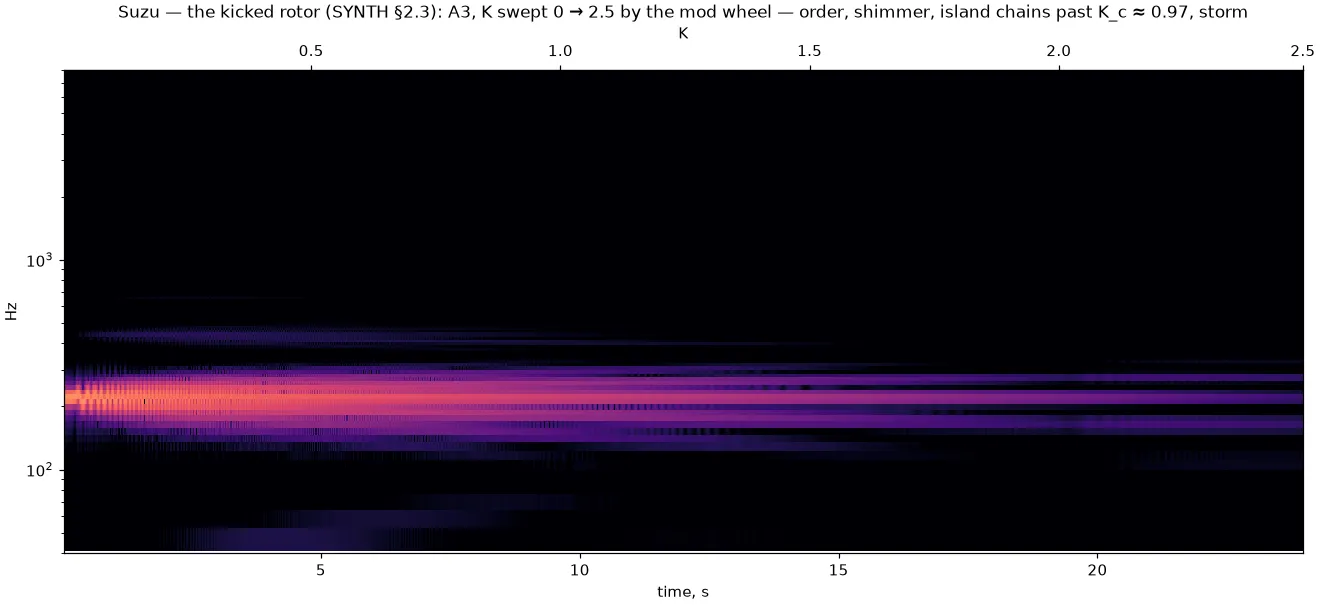
A3 on the rotor, K swept 0 → 2.5 by the mod wheel: the pure tone, the island’s sidebands, the band widening toward the octave about the note past the threshold — the spectrogram of what this page’s demo does to the ink.
midi-sink 2.0.0-rc.5 · AGPL-3.0 · source