
Strings and chaos
The Verlet chain
Section titled “The Verlet chain”Where the modal voice gives a string’s spectrum, the chain gives its body: masses on springs between two fixed ends, every acceleration read from where the neighbours were before the sample began, then velocity, then position — symplectic Euler with a damping each node declares. The scheme has a ceiling: the top mode must stay under Nyquist, which is the CFL bound . Tuning couples the node count, the stiffness and the sample rate, so a note is given as many nodes as the bound allows (48 up to C6, ten at C8) and the stiffness re-derived — the pitch is then exact at every note. A patch that forces the stiffness past the bound is refused at load; with the gate bypassed the harness blows up in twenty-five samples, and that run is archived. Pluck a ringing string and the new triangle is added to what is still moving. Cost is honest: nodes × rate × voices.
The hybrid string
Section titled “The hybrid string”The high-yield architecture: a lossless delay line carries the travelling wave into a bridge of two or three cells — the body’s resonances — through a junction stated as an algorithm. The wave arriving at the bridge is a force on it; the bridge’s own motion radiates back into the string; the reflection leaves for the far end, inverts there, and returns. Written carelessly, such a junction makes energy: the first two forms tried went to infinity in seconds. Written on the cell’s velocity at the position’s time level and with the midpoint rule, its ledger balances exactly per sample: with every declared loss set to zero the loop rings for ten minutes within two hundredths of a decibel.
A bridge pulls the string’s pitch — up to a semitone near its own resonance, the wolf. The junction is linear, so its reflection phase at the note is solved in closed form when the string is tuned and folded into the delay line’s fraction (a Thiran allpass): the fundamental sits on the note everywhere, and the pull stays in the partials, where the body belongs.
Passivity is gated twice. At patch load the closed loop is simulated for three hundred round trips with every declared damping zeroed, and a patch whose junction gains is refused with a message — no patch can dodge it. And the ten-minute soak above. The reflection’s gain is a lab knob whose conserving value is exactly one; five percent over it, with the probe bypassed, the loop goes non-finite in half a minute.
Karplus–Strong’s averaging filter is here as a declared loss, a one-zero with gain at most one. Its loss is per round trip, so a high note is short in seconds — as on a real string.
The Duffing cell
Section titled “The Duffing cell”The magic circle with a hardening spring: the kick reads . It is still symplectic — a shear of one coordinate by a function of the other — and its pitch depends on its amplitude: struck hard, C4 clangs two and a half semitones sharp and settles onto the note within six tenths of a second as its declared decay shrinks the orbit, a gesture no wavetable owns. The settled pitch needs no compensation: the cubic vanishes with the orbit. Driven by a sinusoid whose amplitude is the press, it is the second chaos voice: at a drive of 0.87 the single partial bifurcates into a comb.
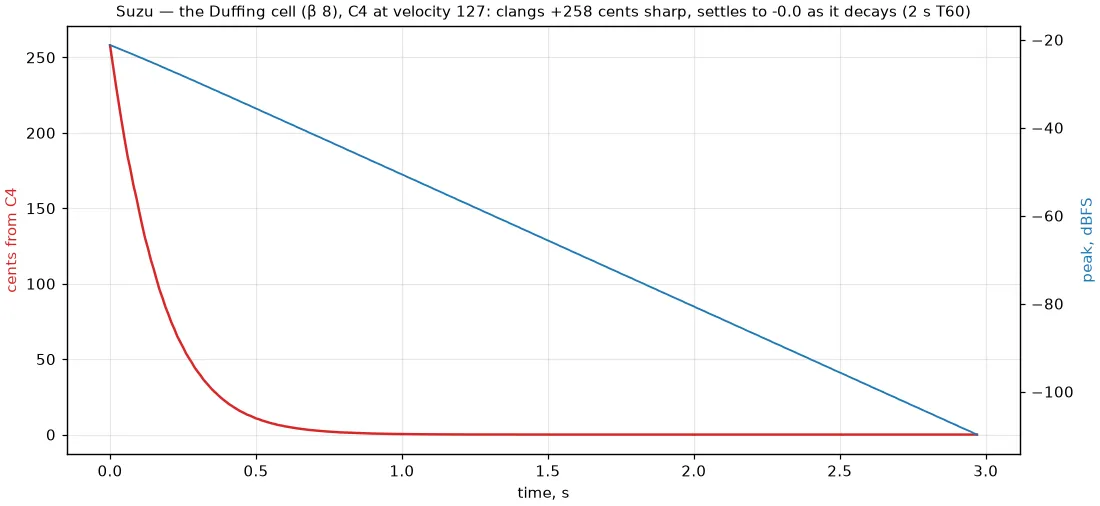
C4 struck hard on the Duffing cell (β 8): 258 cents sharp at the strike, settling onto the note within six tenths of a second while the amplitude falls along its declared straight line.
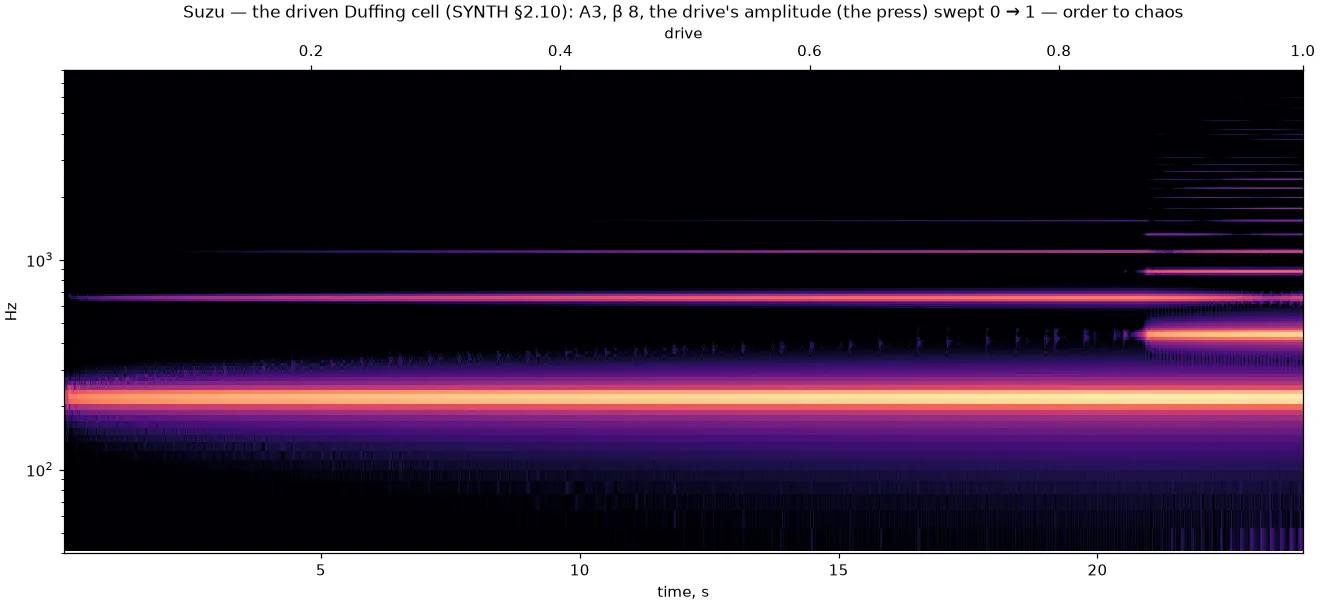
A3 driven at the note, the press swept 0 → 1: one partial and its harmonics until a drive of 0.87, then the bifurcation — a comb of new partials.
The kicked rotor
Section titled “The kicked rotor”Chirikov’s standard map as an oscillator. The cell carries the angle; once per cycle of the note the momentum is kicked by and wrapped onto its torus, and the momentum is the pitch, within the octave about the note — the cell re-based onto , never a jump. is the pure tone. Small : the momentum breathes slowly round an island and the tone shimmers with orderly sidebands. Near the last invariant torus breaks; past it the momentum diffuses across the band and the tone is pitched noise that still remembers its fundamental. The mod wheel sweeps — the patch’s rotor K up to 2.5 — smoothed over 20 ms so its steps never land as jumps: the same controller can tear the water on the Chirikov canvas and the tone at once. One theorem, two senses.
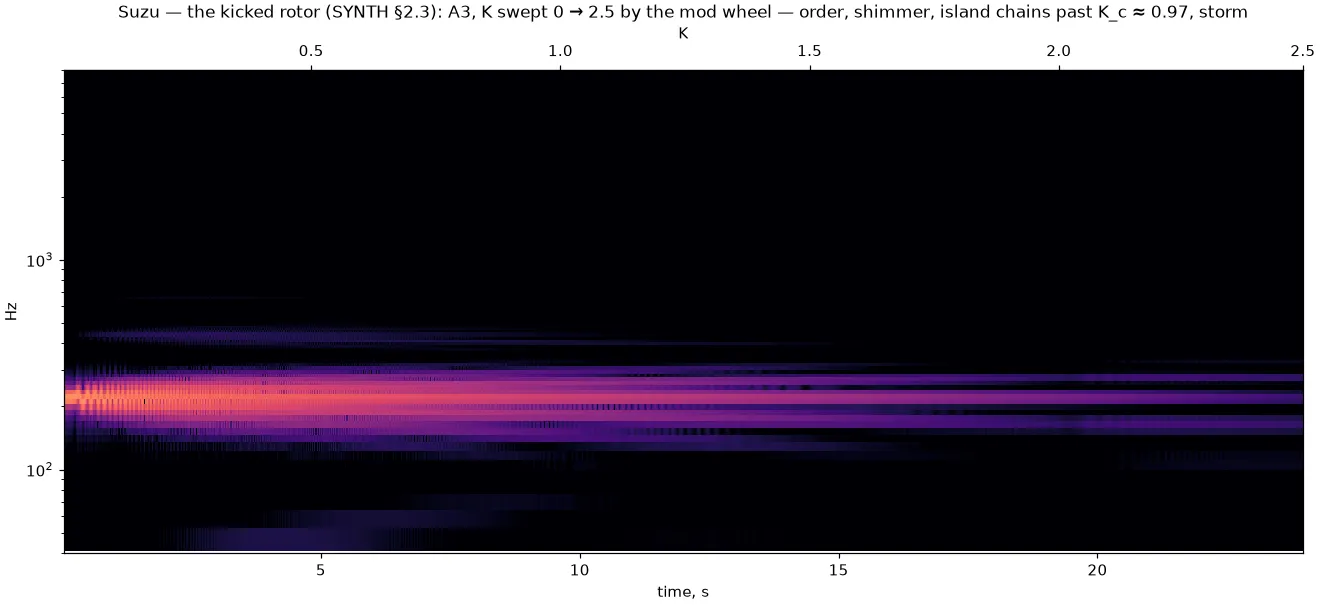
A3 on the rotor, K swept 0 → 2.5 by the mod wheel: the pure tone, the libration’s sidebands, the band widening toward the octave about the note past the threshold.
The chaotic modulator
Section titled “The chaotic modulator”A double pendulum at control rate, its energy set by each strike’s velocity: a soft note swings, a hard one tumbles chaotically. Its output is bounded by construction and routed to one smoothed parameter — the cutoff, the coupling, the rotor’s or the drive — as the patch’s organic drift. The spec asked for a leapfrog; the double pendulum’s Hamiltonian is not separable and a leapfrog is not symplectic for it (it drifted to nonsense in minutes), so the integrator is RK4 with the energy projected back to the trigger’s value after each step — a correction that measures as a no-op and bounds by construction: the projected class.
Both at once
Section titled “Both at once”The sampler and Suzu can sound together: on the layered source every note strikes a sampled voice and a synth body in the same voice. That is how the combined stress runs — the fifteen-channel storm with a heavy piano library under the Verlet chain, twelve voices, no dropouts.
The profiles
Section titled “The profiles”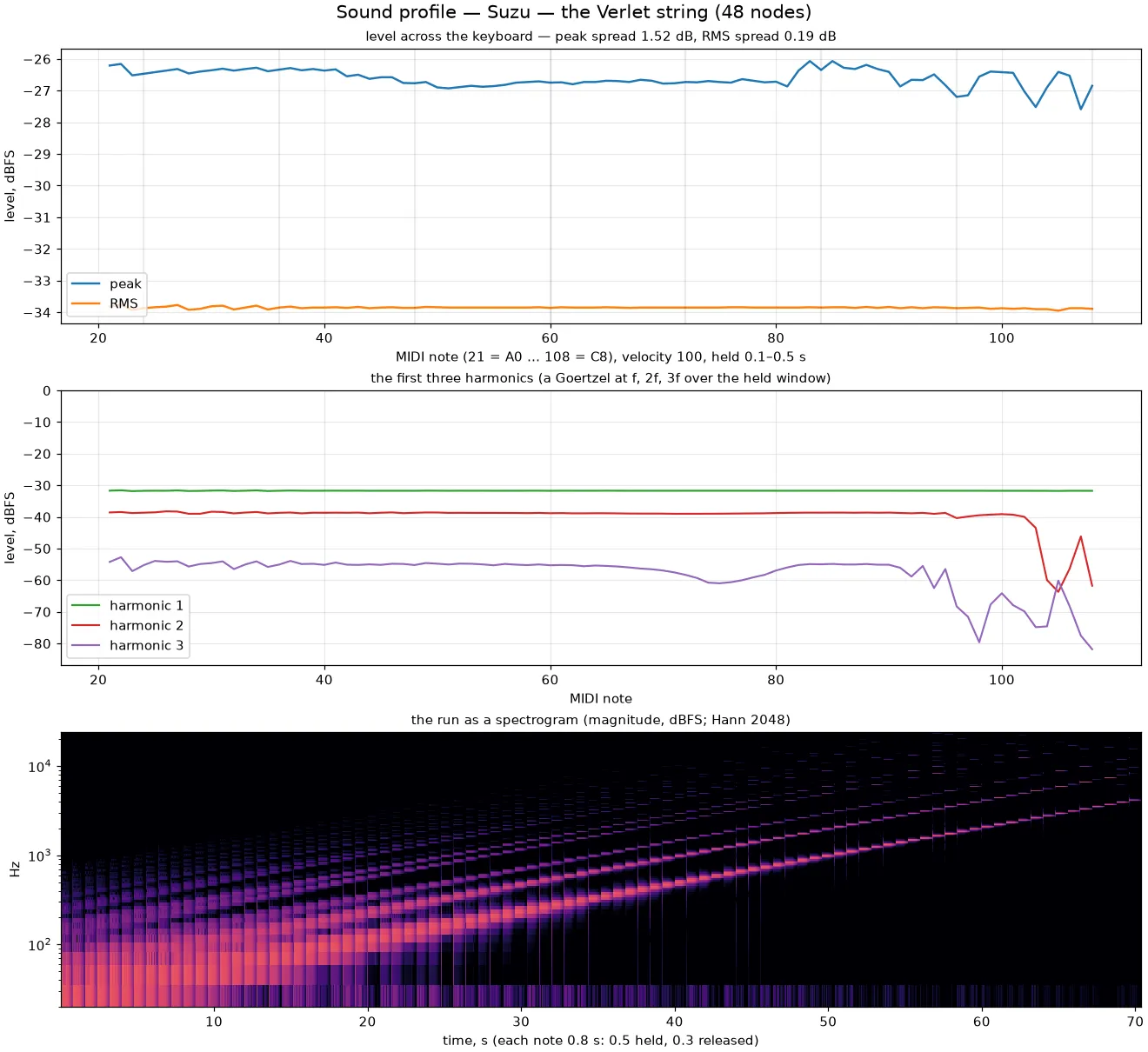
The Verlet chain: forty-eight masses on springs between fixed ends, plucked as a triangle and read at a quarter of the length. Its comb is the discrete string’s — the highs compress toward the top mode — and the level is flat to a decibel and a half. Above C6 the chain sheds nodes to stay under its stability bound; the pitch is exact by construction at every note.
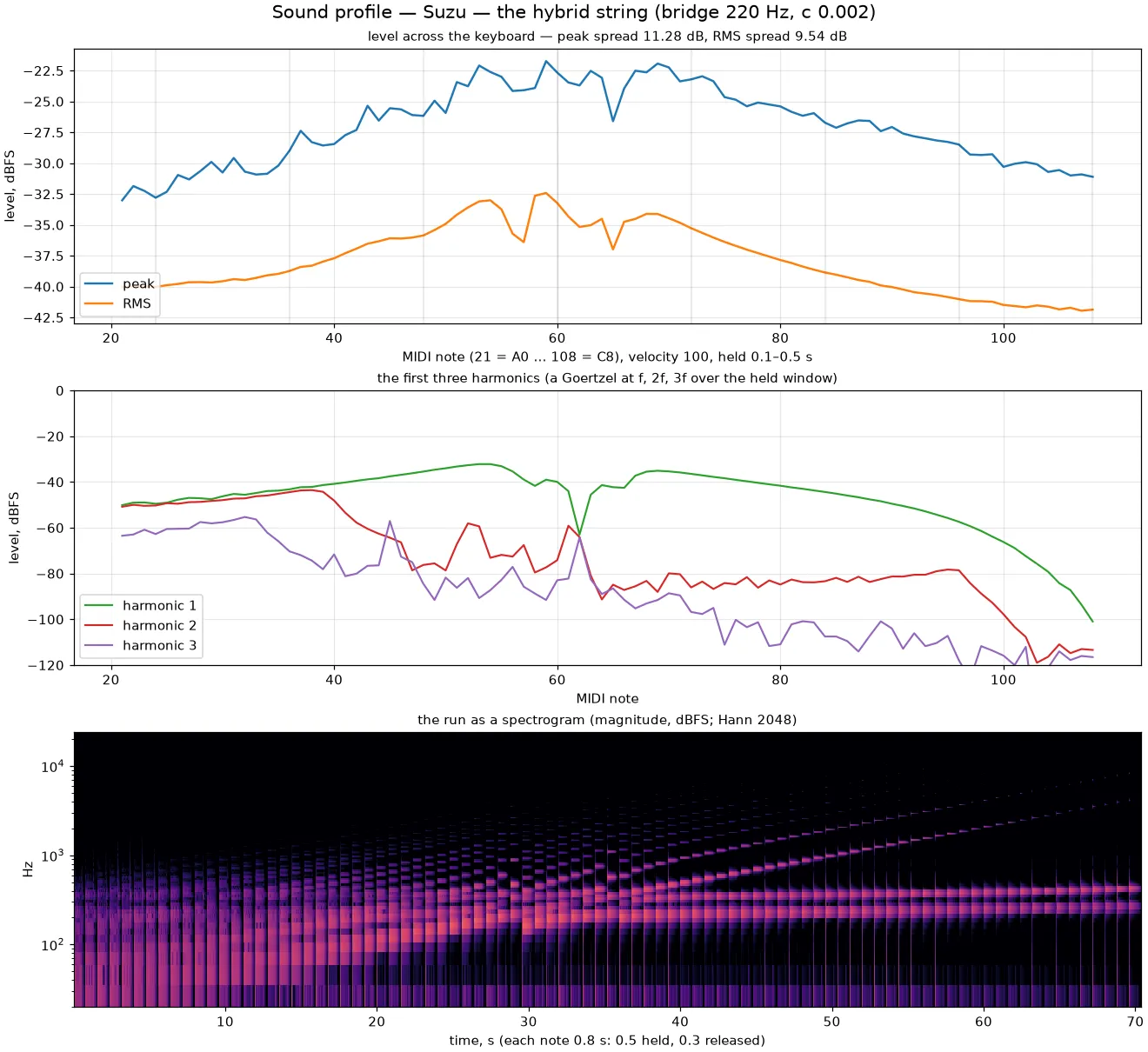
The hybrid string: the output half the string at the pickup and half the bridge’s motion — the body. So the level across the keyboard is the body’s response: the notes around the bridge’s two modes (220 and 356 Hz) come out louder, the wolves sit as dips exactly at them where the string’s energy leaves for the bridge, and the top octave falls by Karplus–Strong’s law. The fundamental sits on the note everywhere (0.14 cent).
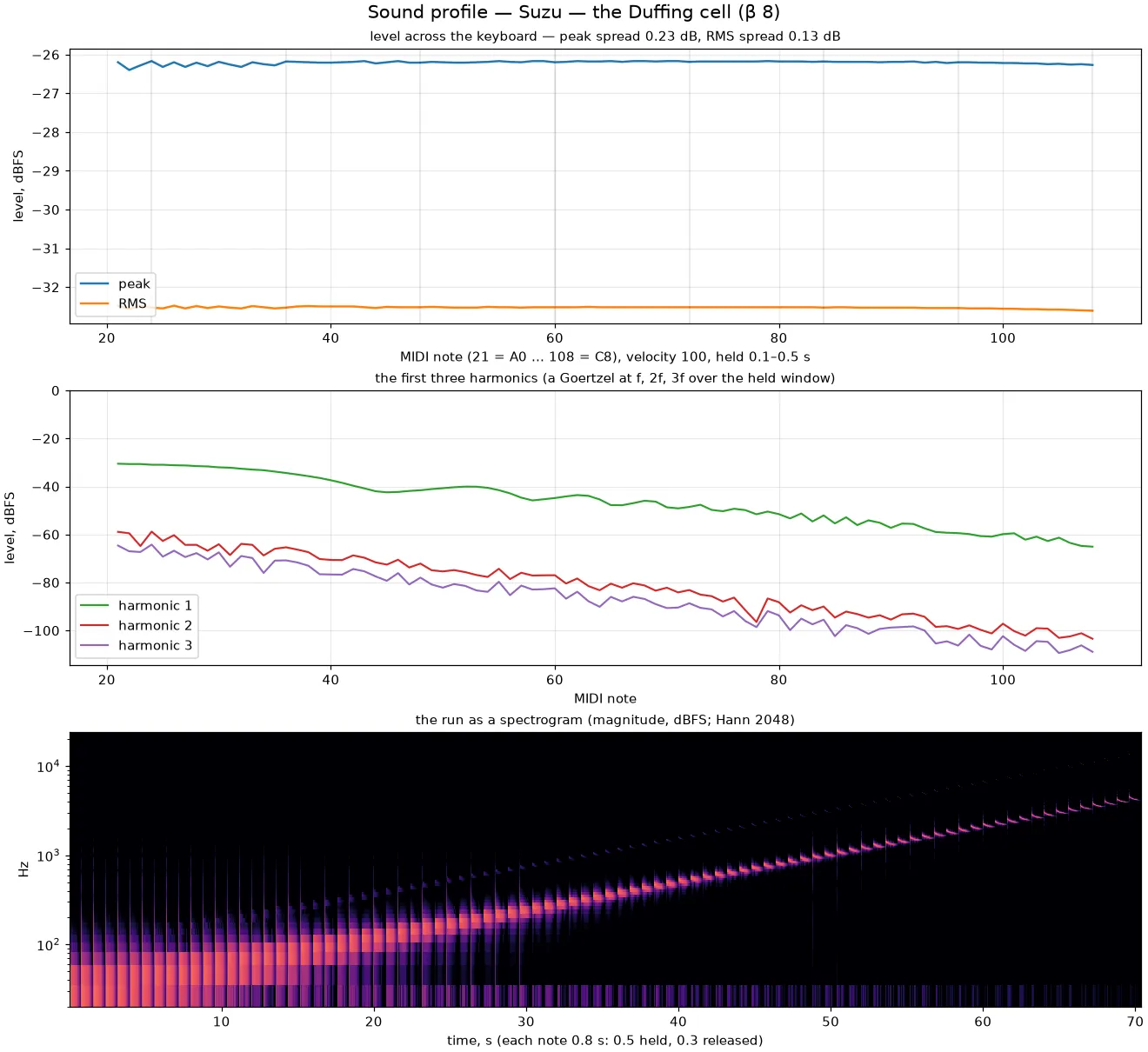
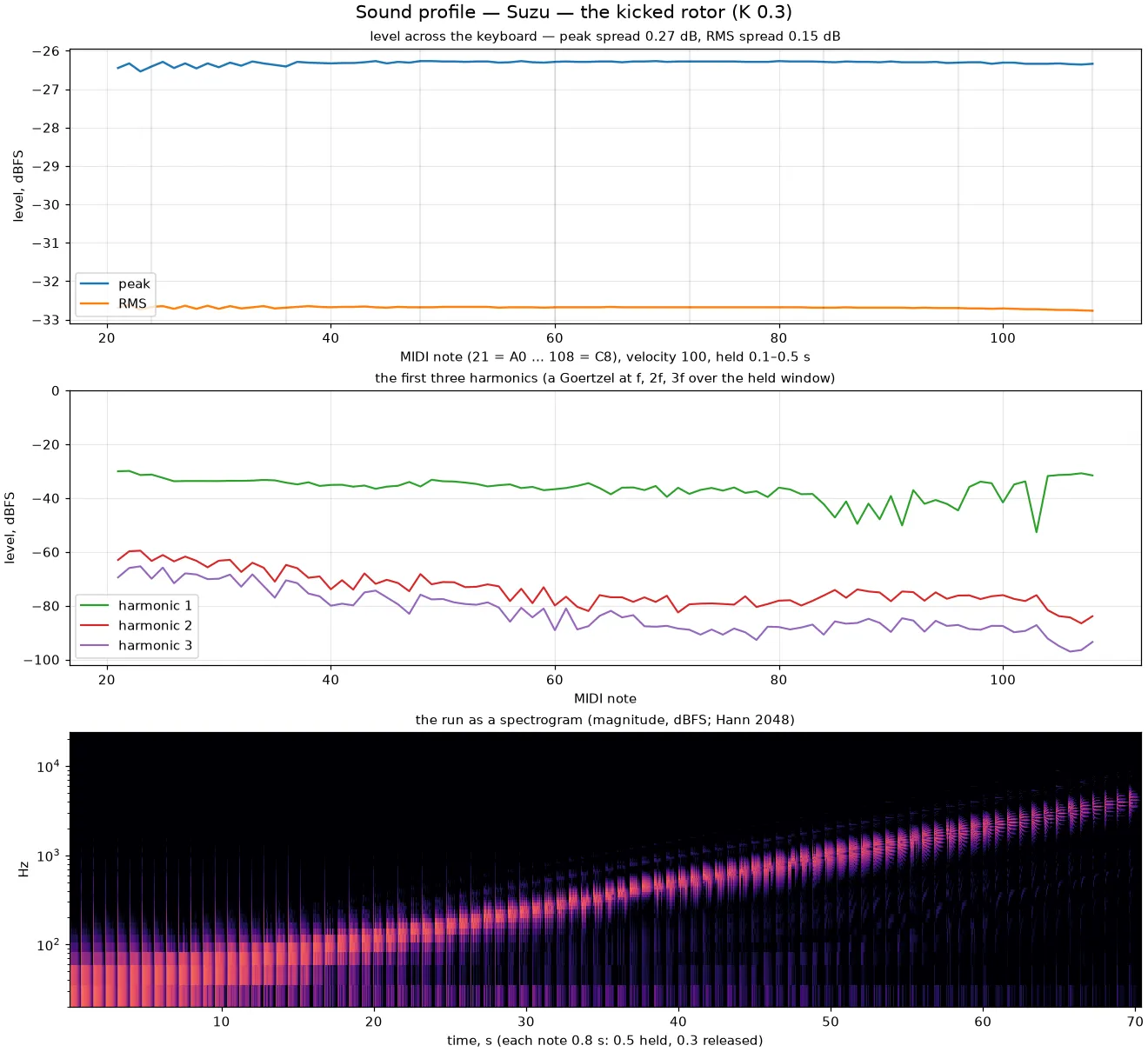
The Duffing cell at velocity 100 — a modest clang in the first cycles and the odd harmonics of its cubic spring — and the kicked rotor at K = 0.3, the island’s slow libration putting sidebands around every note.
midi-sink 2.0.0-rc.5 · AGPL-3.0 · source