
The sound profiles
Every synth voice ships with its sound profile; it is the author’s rule,
and the figure goes into each step’s evidence before the voice is called
done. Each figure strikes every MIDI note from A0 (21) to C8 (108) at
velocity 100, holds it half a second and releases it for three tenths,
offline through the same voxo_render the callback runs, and shows three
things: the level across the keyboard (the held window’s peak and RMS,
dBFS), the first three harmonics per note, and the run as a spectrogram.
The desktop bench regenerates any of them: midi-sink --dev --voxo-profile <dir> with --voxo-suzu-voice <kind> or --voxo-suzu-preset <n>, then
tools/sound_profile.py.
Every voice profiled here can be played in the Suzu lab, the engine itself in the browser.
The cells
Section titled “The cells”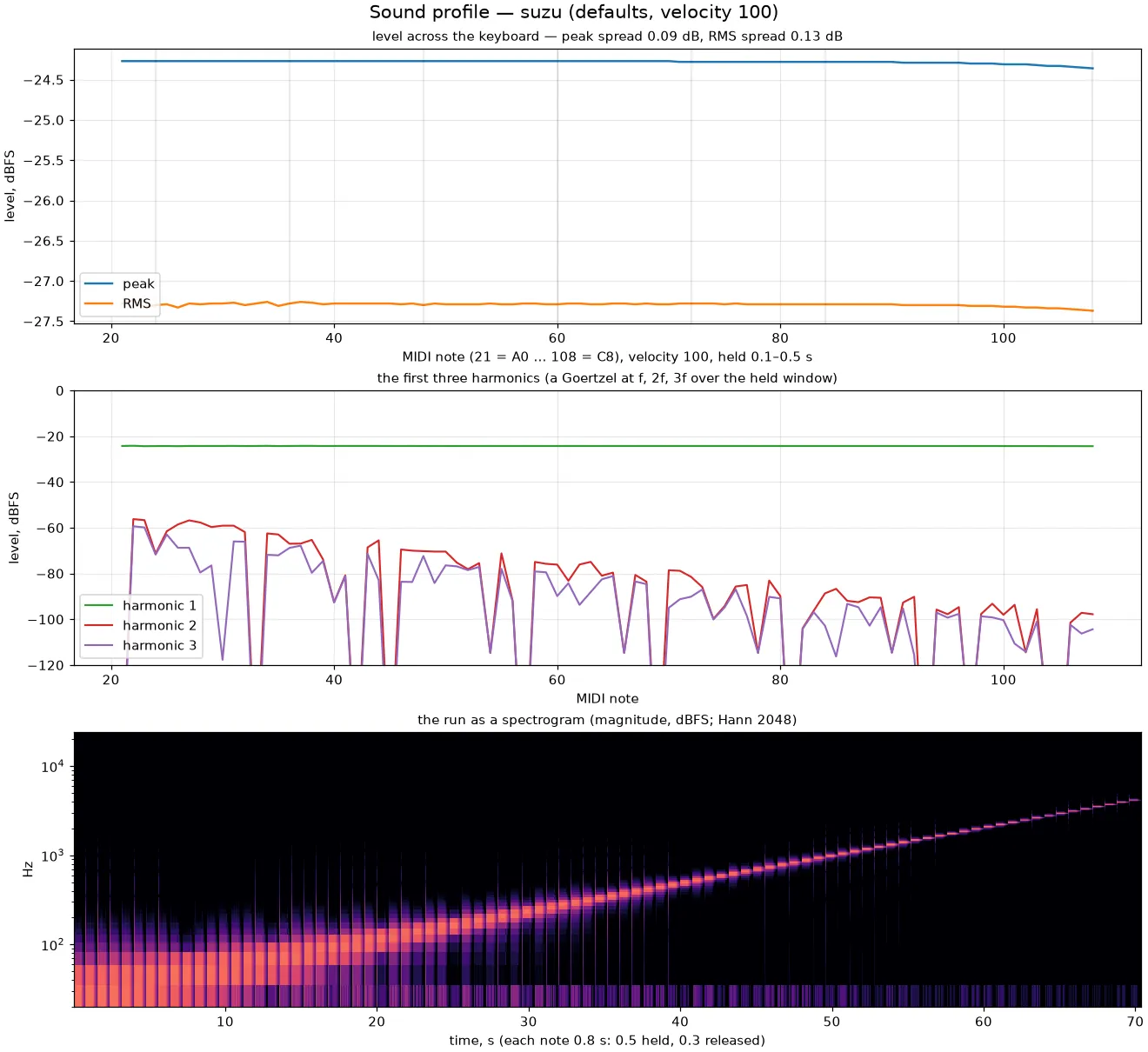
A magic-circle cell per voice: a pure sine at the same amplitude on every note — flat to a tenth of a decibel from A0 to C8 — with no harmonics (the faint second and third are the measurement’s own leakage). What a listener hears vary in the bass is not in the signal: a sine at 30–60 Hz sits where the ear’s equal-loudness curve and a small speaker give little back, and unevenly.
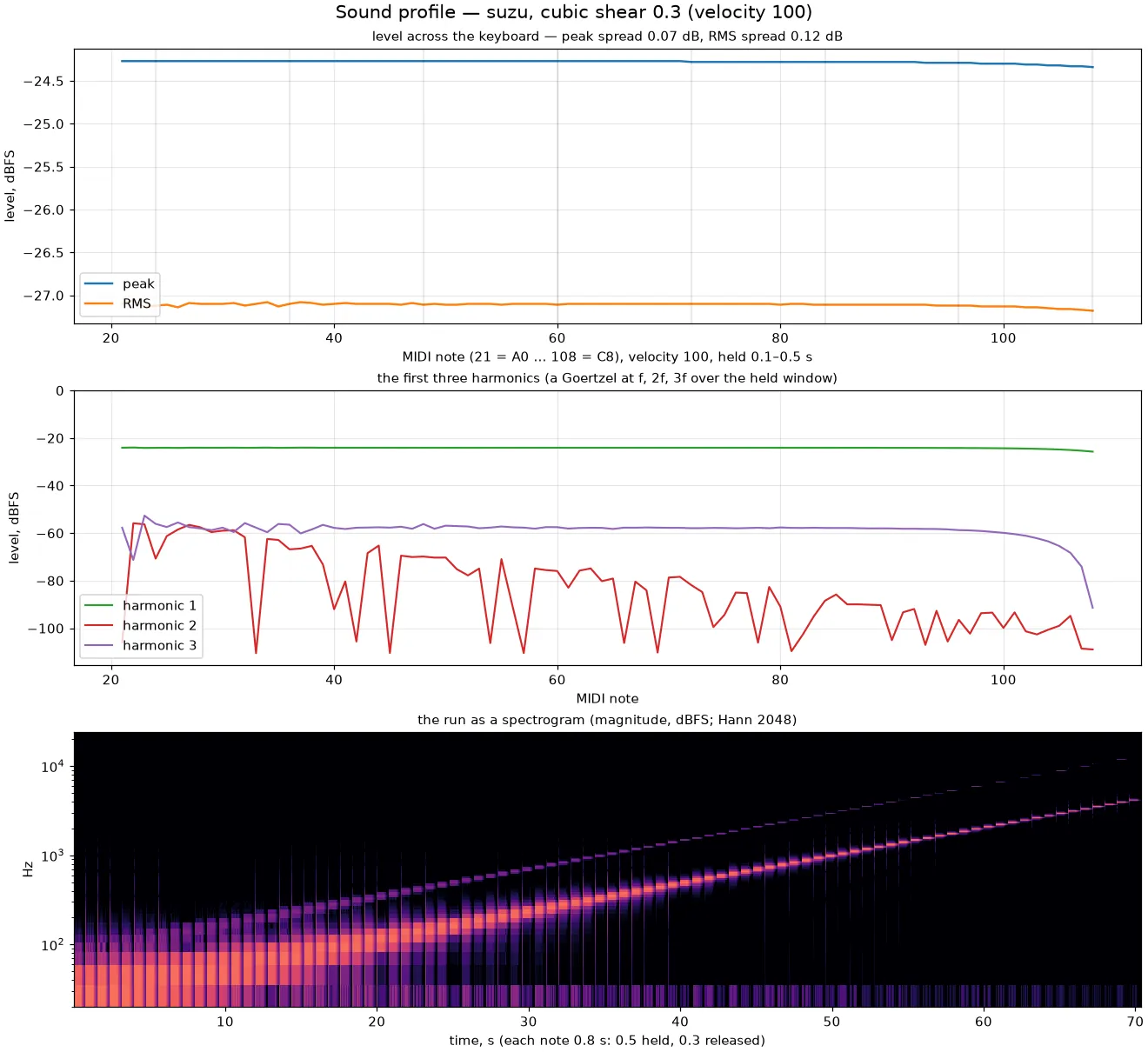
The phase-space shear at 0.3 — an area-preserving map — adds odd harmonics without moving the level or the pitch: the cell calibrates the shear’s detune at start-up and compensates it, so every note stays within a fifth of a cent at full gain. The third harmonic sits 33 dB under the fundamental here and 23 dB under at full gain.
The sampler, for reference
Section titled “The sampler, for reference”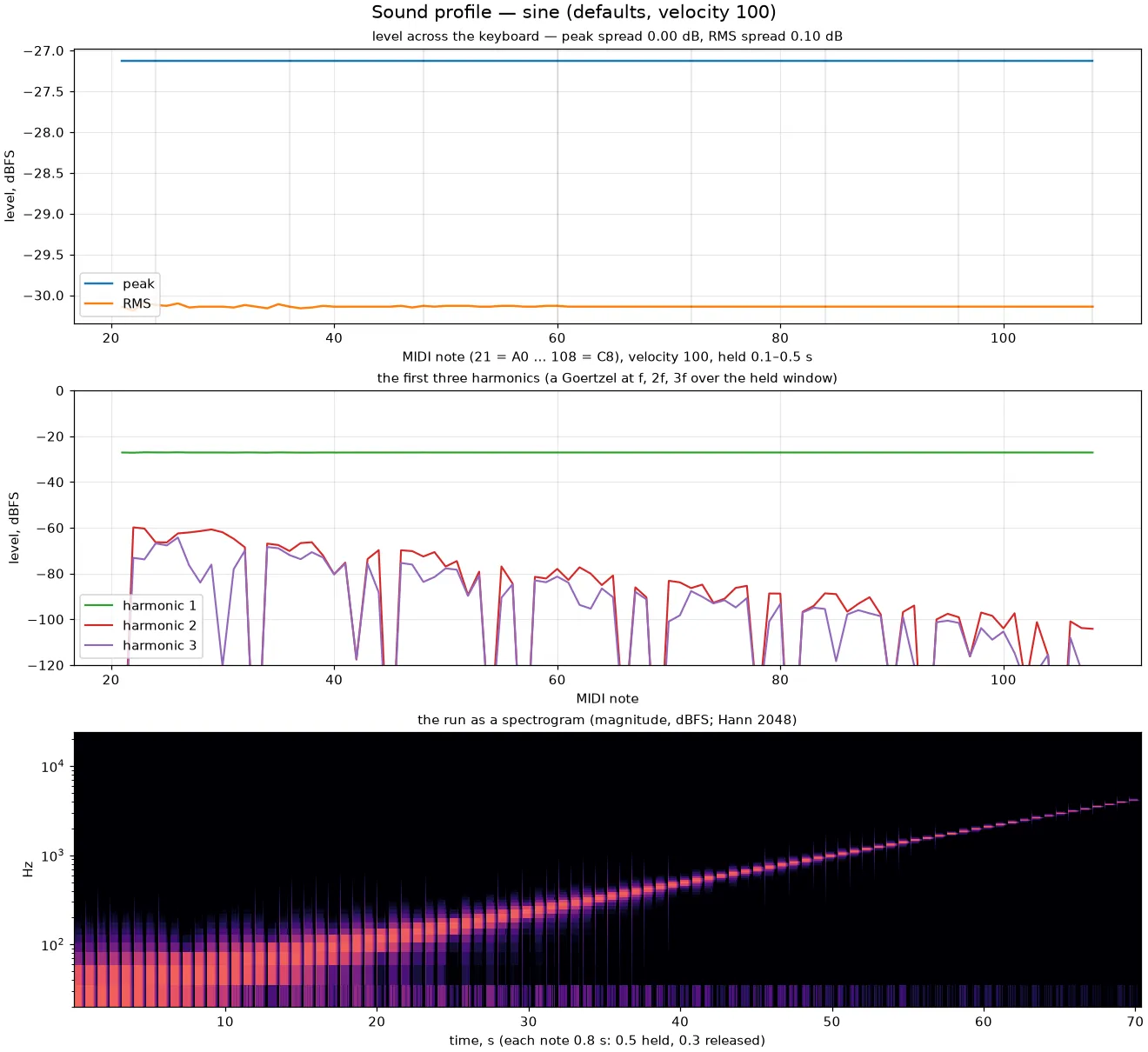
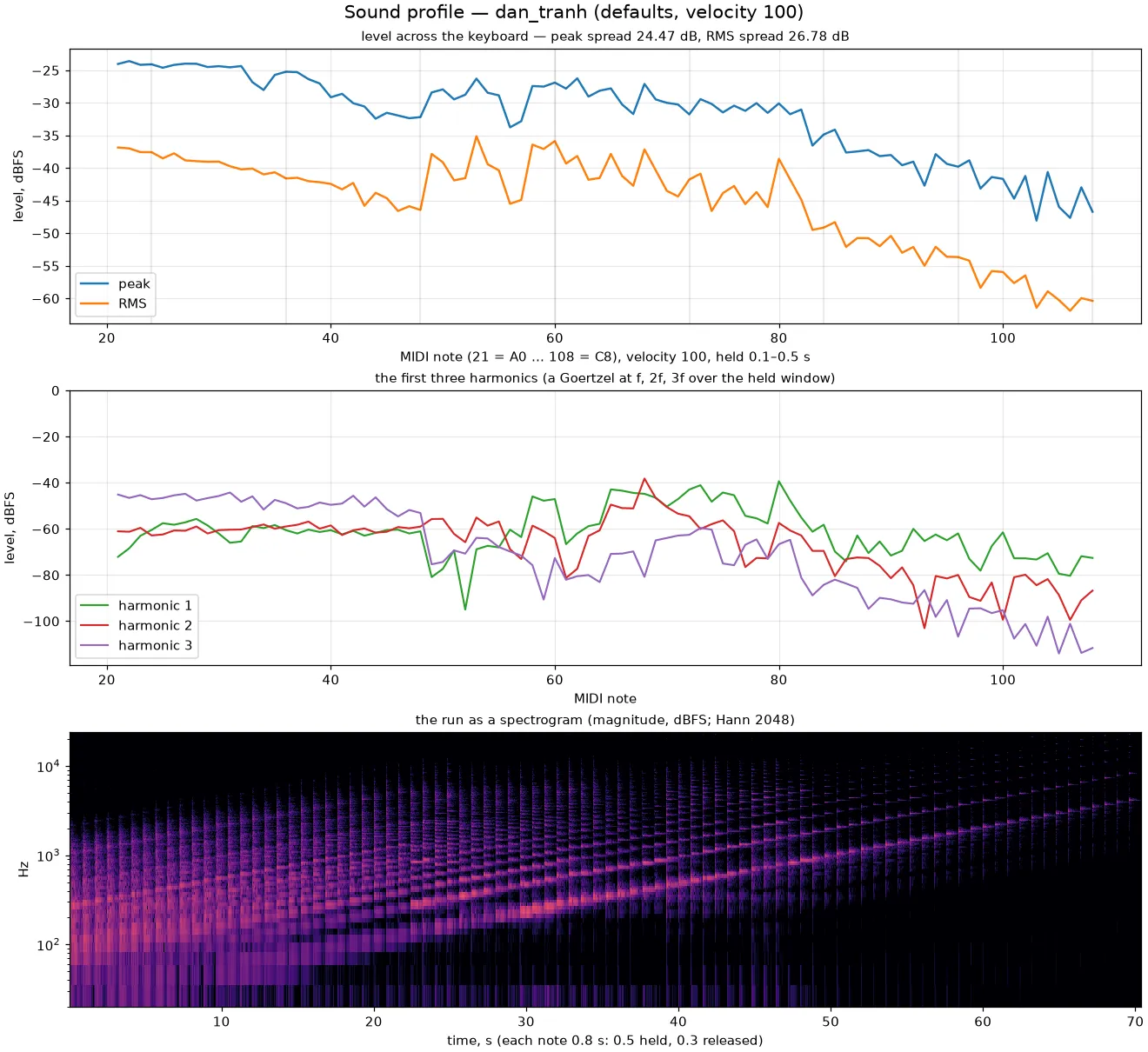
The sampler’s own sine, and the Dan Tranh demo: sixteen samples of one articulation stretched across the keyboard — the library’s own profile, the low zones loud, the top faint, a 24 dB spread — which is what a sampled instrument is, and why a synth’s flat line is worth showing beside it.
The modal voice: the five presets
Section titled “The modal voice: the five presets”Eight modes, coupling 0.05, the defaults.
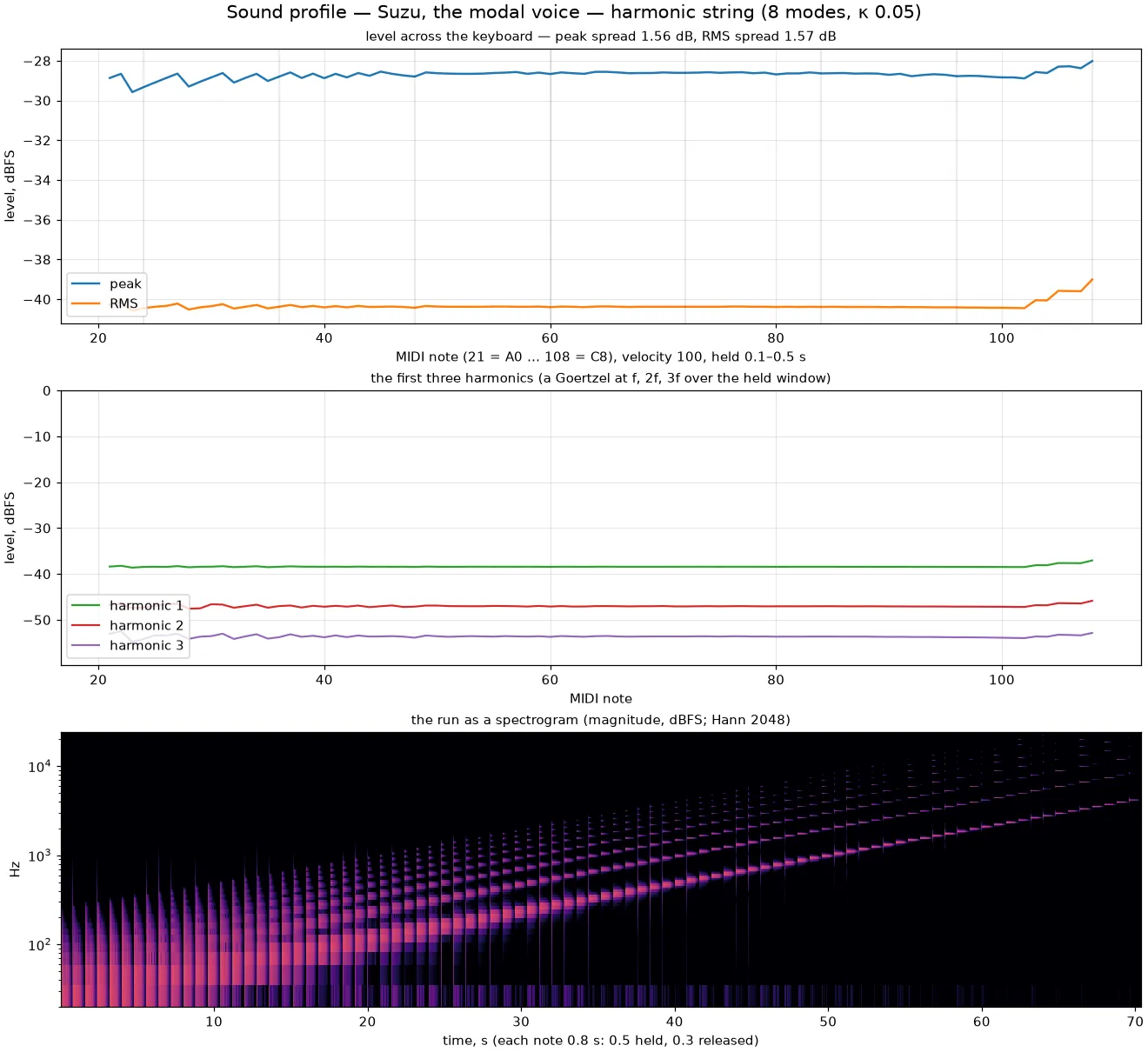
The harmonic string: partials at 1, 2, 3 … with weights 1/k, the highs decaying first. The second sits 8 dB under the fundamental, the third 14. Above C7 the upper partials cross the 24 kHz ceiling and are muted.
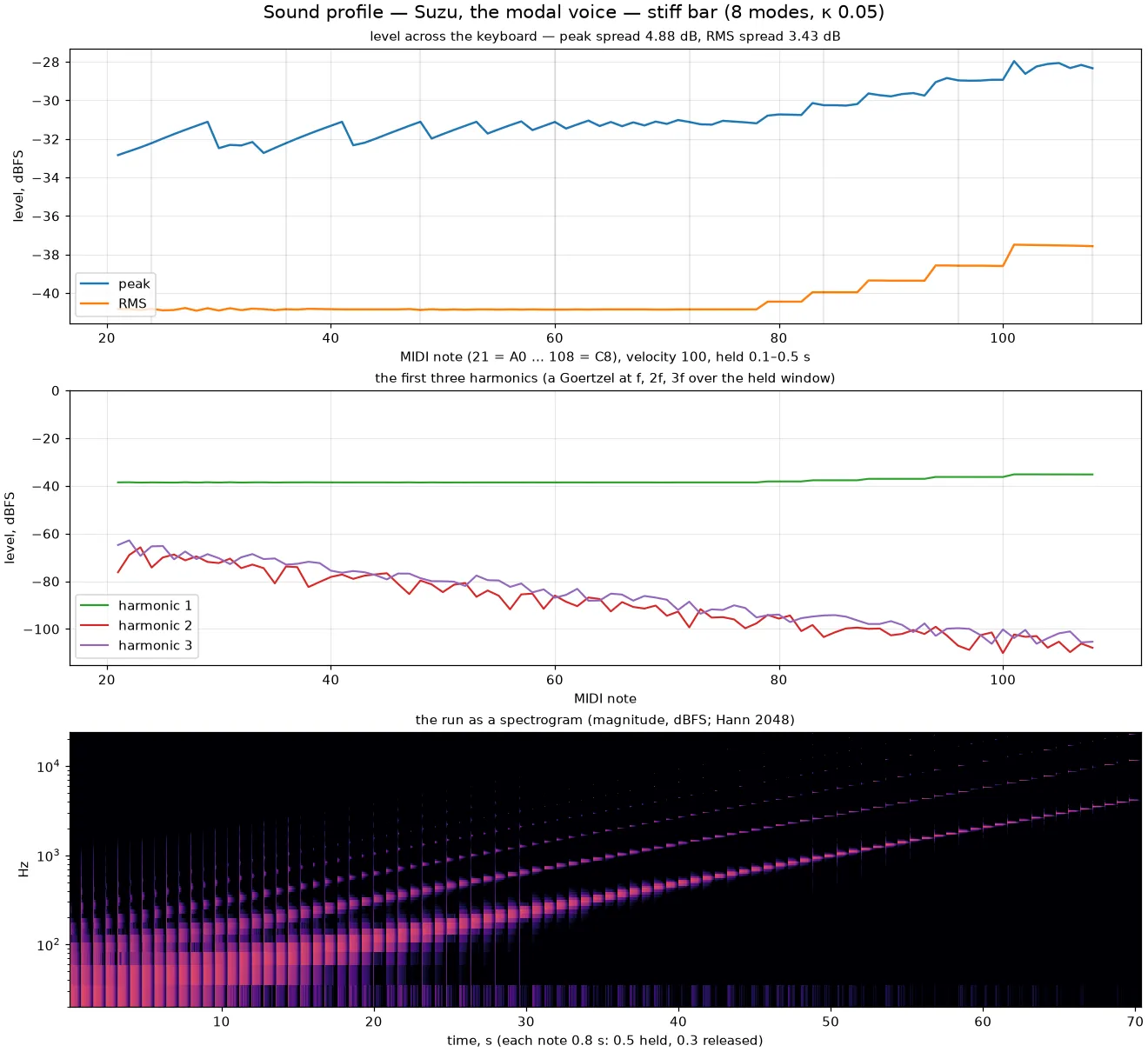
The free bar’s ratios, 1, 2.78, 5.44, 9, 13.4 …: by C4 most of them are past the ceiling. The 5 dB spread across the keyboard is the instrument’s own — a bar’s high notes have fewer partials.
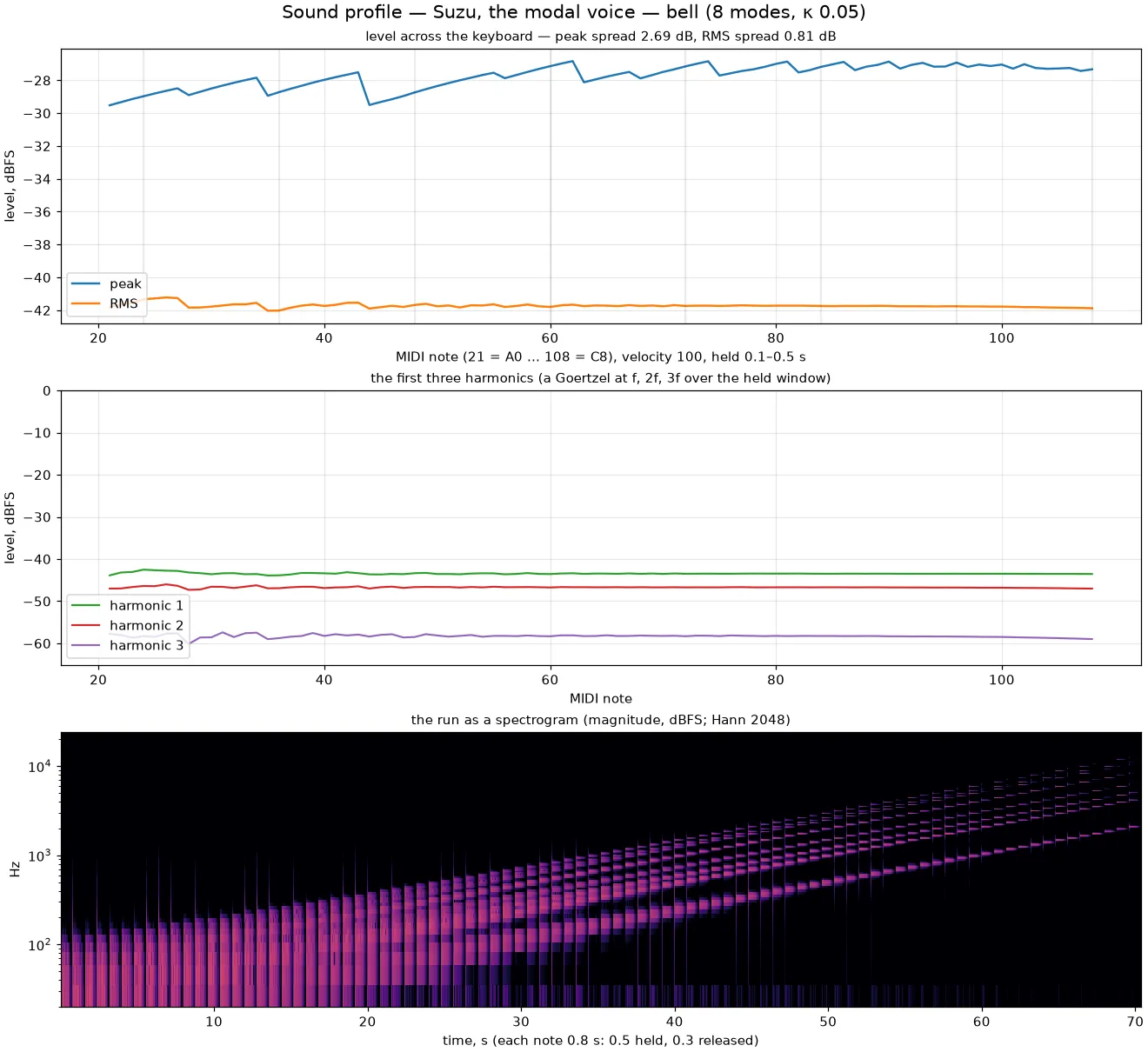
The bell: the hum an octave under the prime, the tierce, the quint, the nominal and the cluster above. What the harmonic tracker calls “harmonic 2” here is the nominal, exactly an octave up; the peak line’s sawtooth is the measurement’s own, the RMS underneath flat to 0.8 dB.
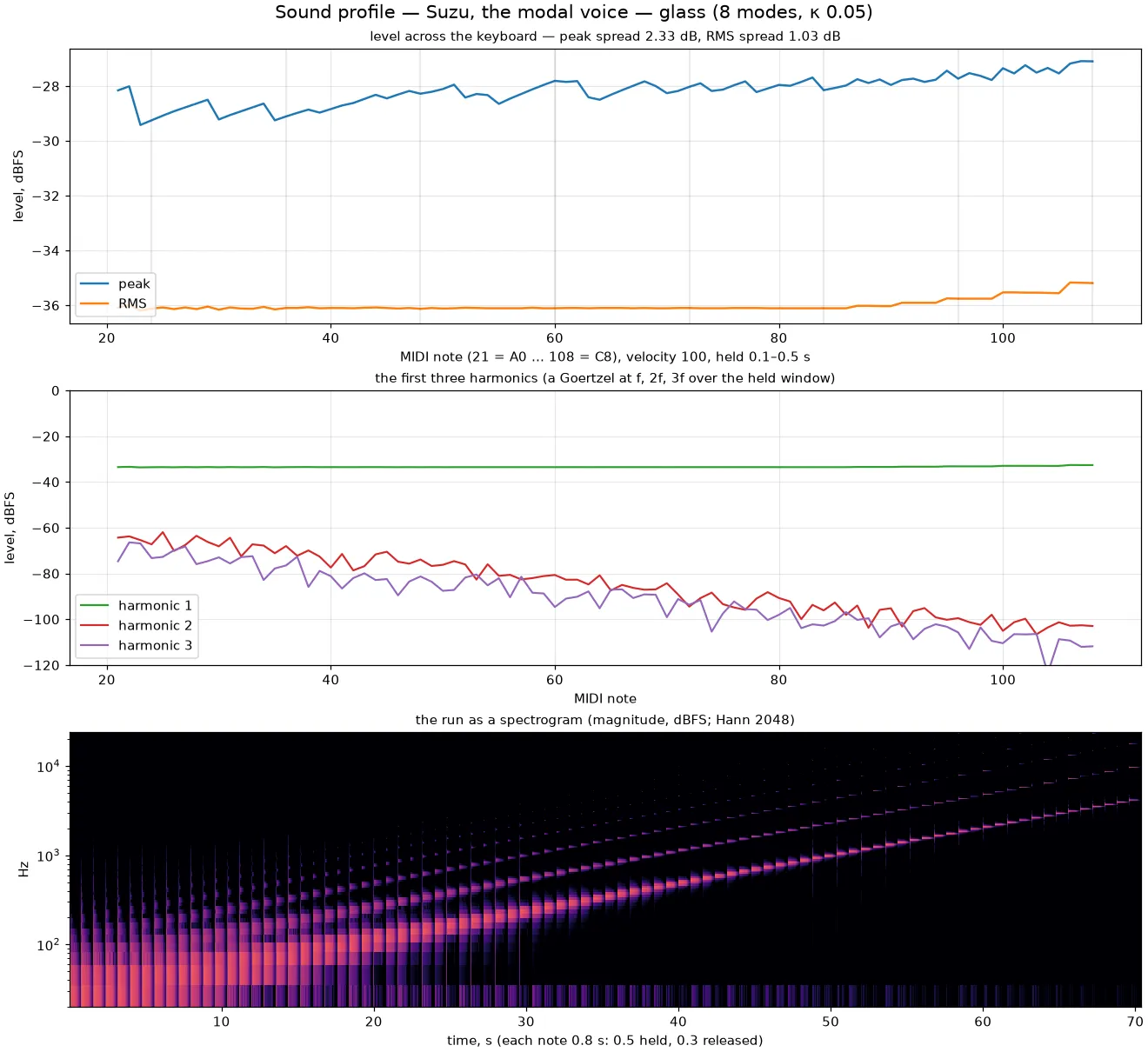
Glass (1, 2.32, 4.25, 6.63 …, weights 1/m²): nearly a sine with a faint inharmonic ring.
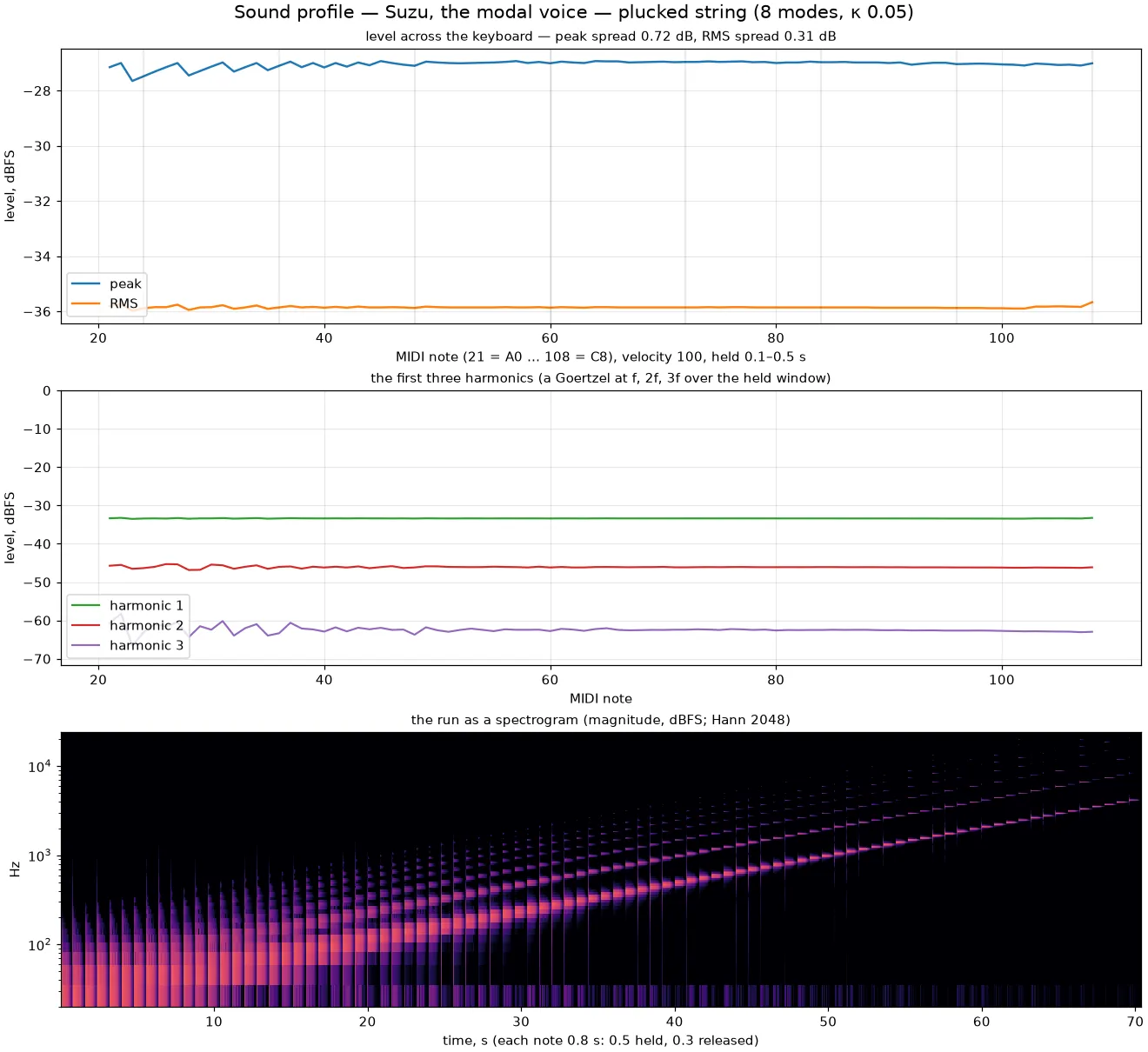
The plucked string, Karplus–Strong in modal form: partials at k·√(1 + Bk²), fed by the pluck position in closed form — sin(kπp)/k², the triangular pluck’s spectrum. At p = 0.28 the comb is what you see; pluck at the middle and the even partials vanish.
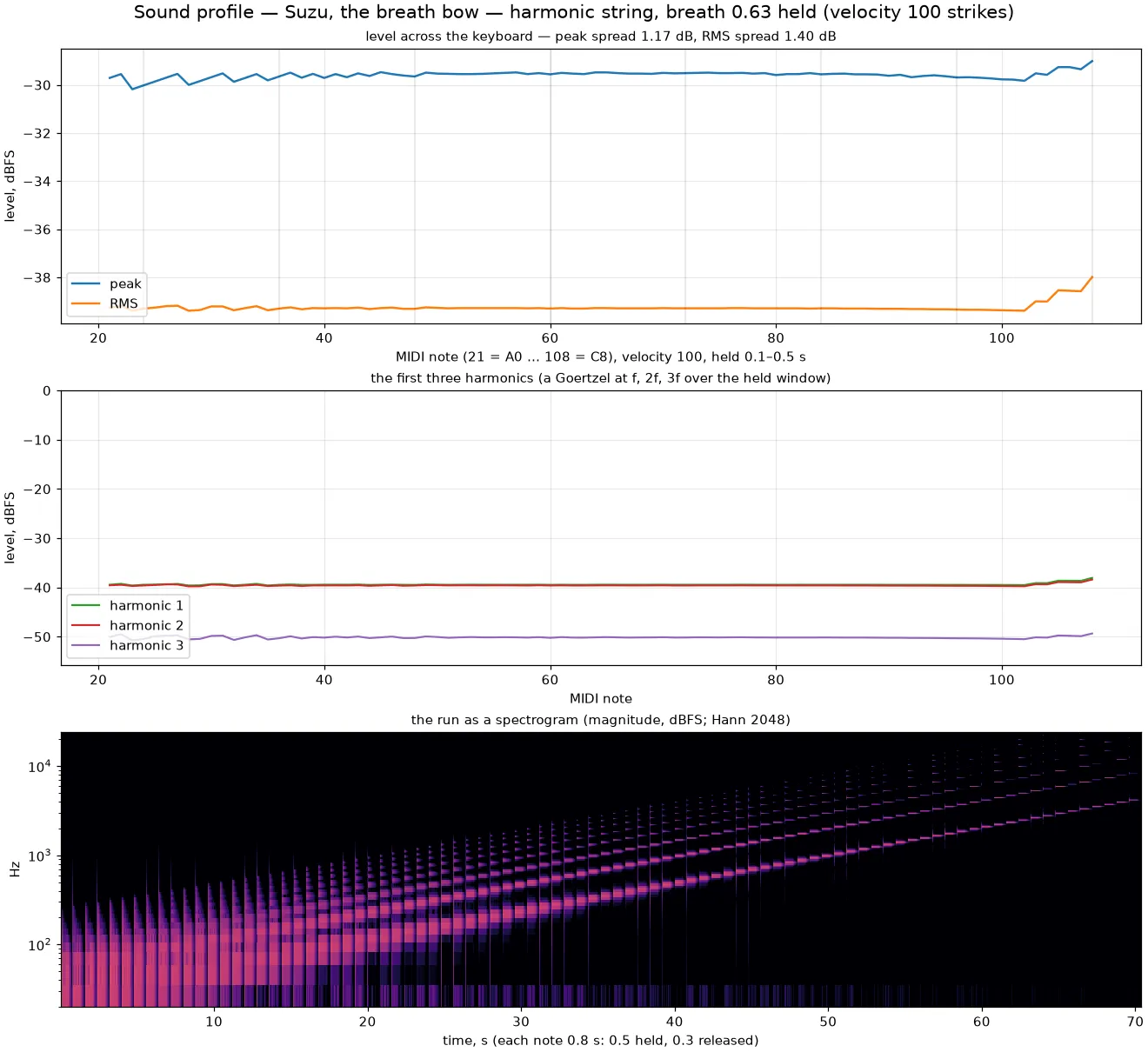
The breath bow on the harmonic string, breath 0.63 held through every strike: a flat singing line across the keyboard.
The strings and the chaos voices
Section titled “The strings and the chaos voices”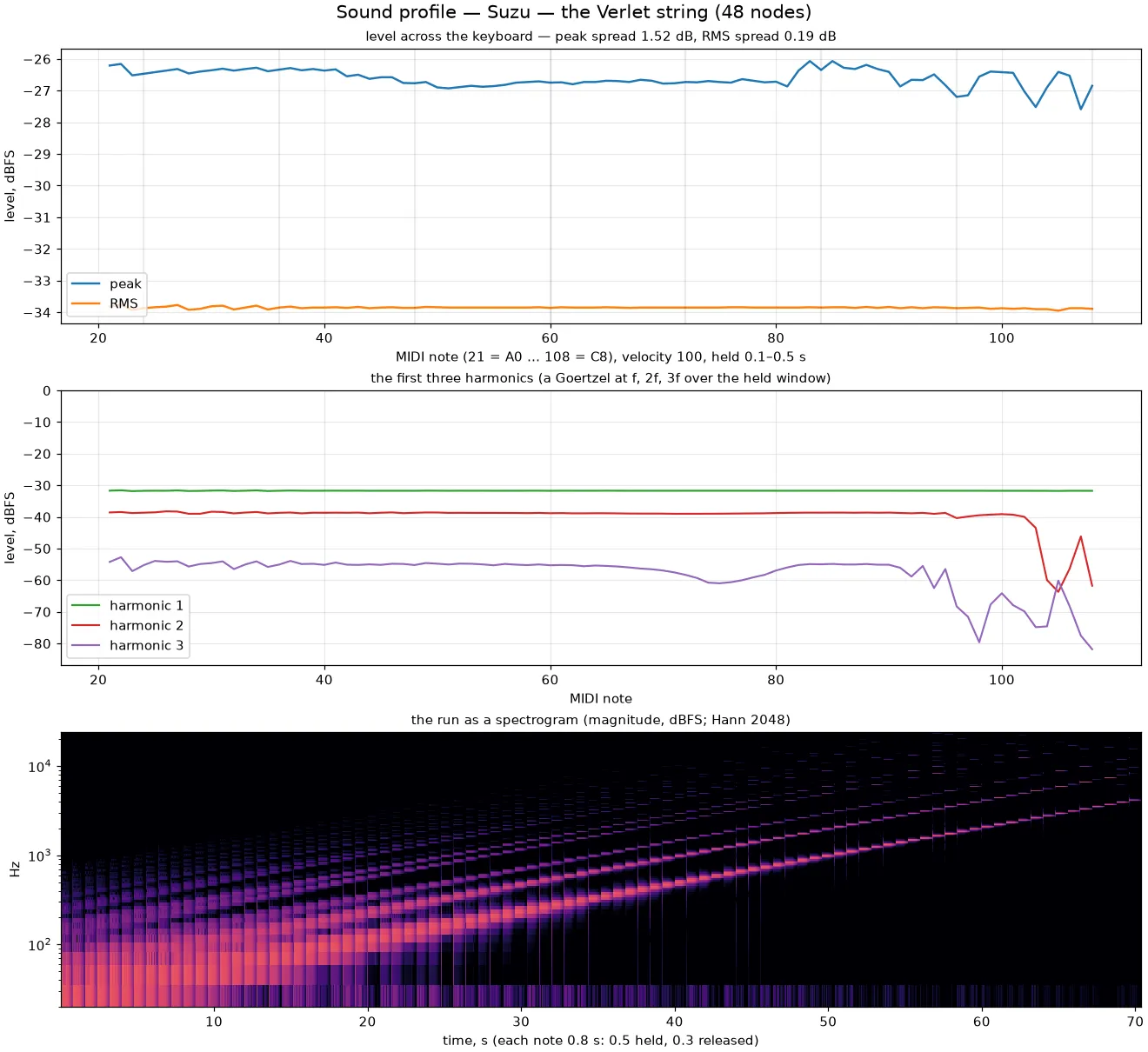
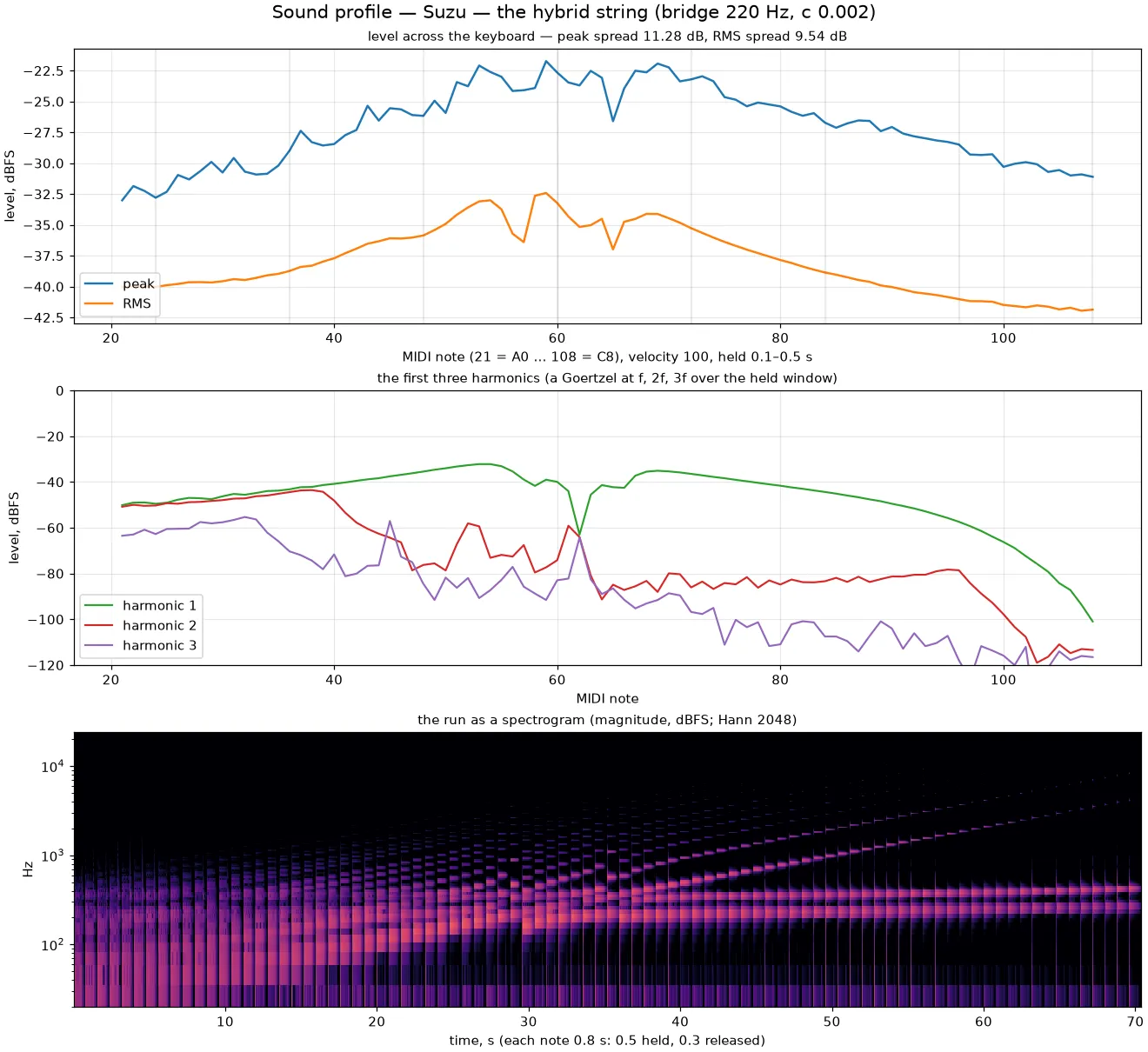
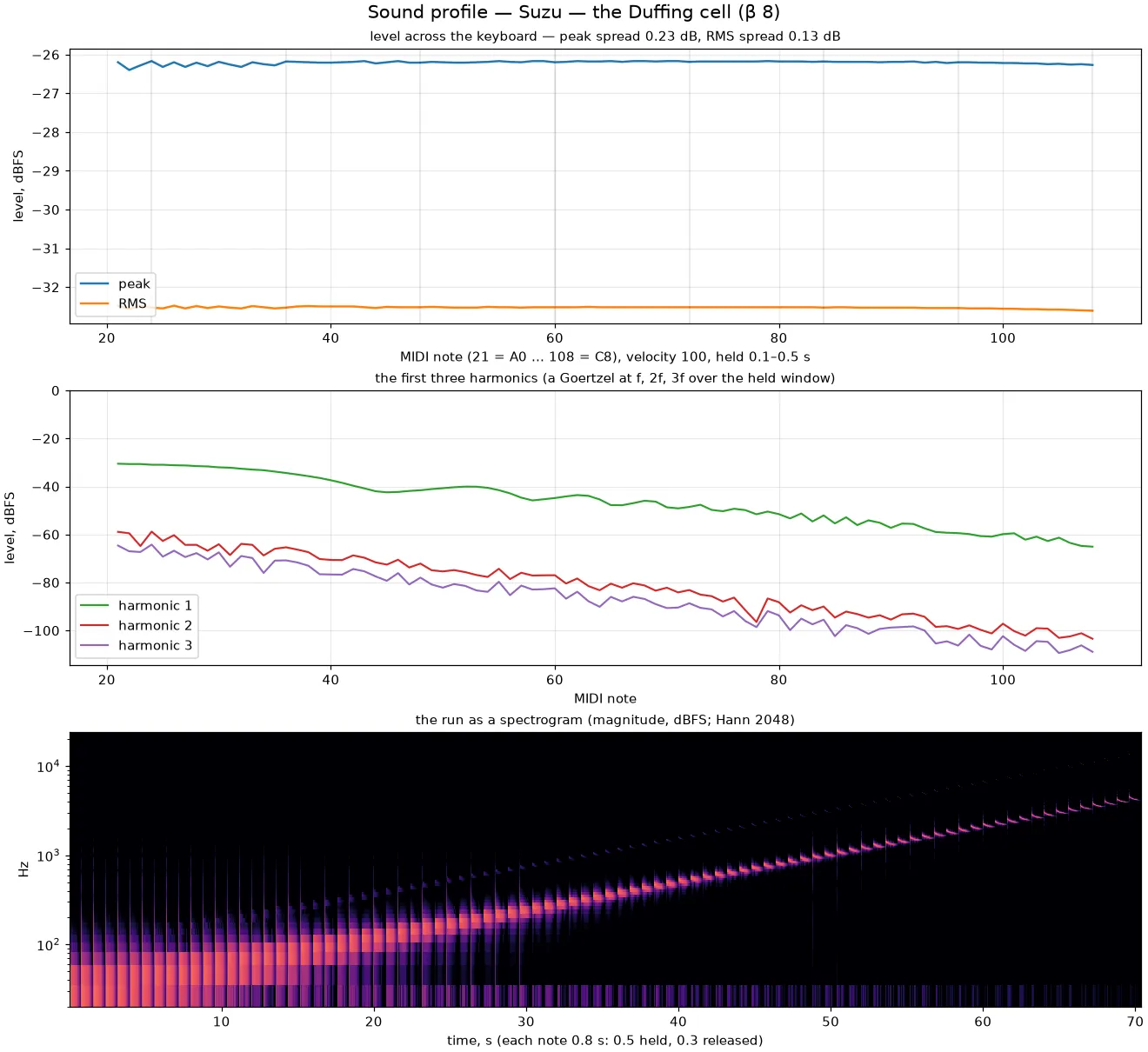
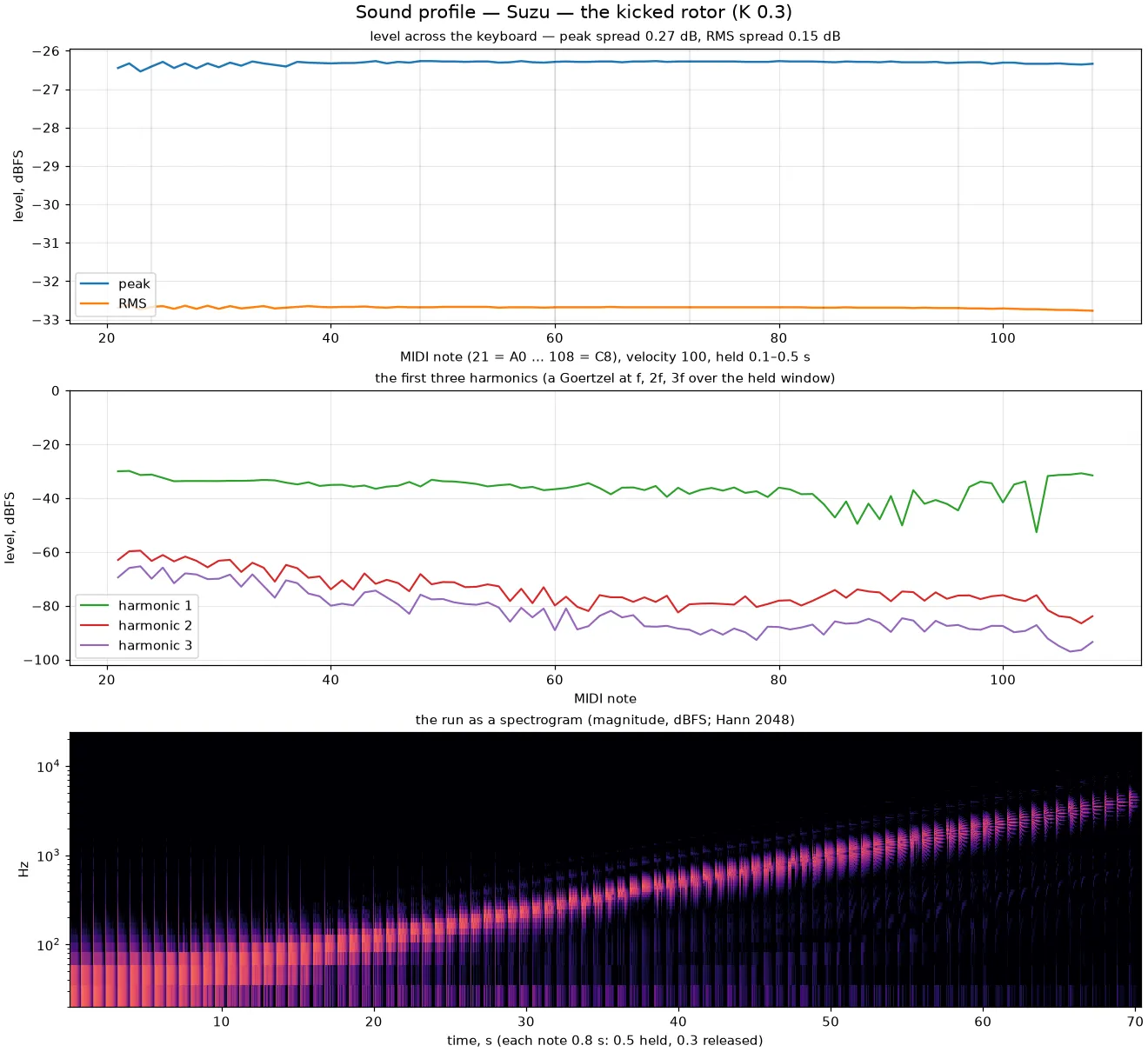
The Verlet chain’s comb (the highs compressed toward the top mode, the level flat to a decibel and a half), the hybrid string’s body response (louder around the bridge’s two modes at 220 and 356 Hz, the wolves as dips exactly there), the Duffing cell’s clang and odd harmonics, and the rotor at K = 0.3 with the island’s sidebands. The chapter: strings and chaos.
The winds
Section titled “The winds”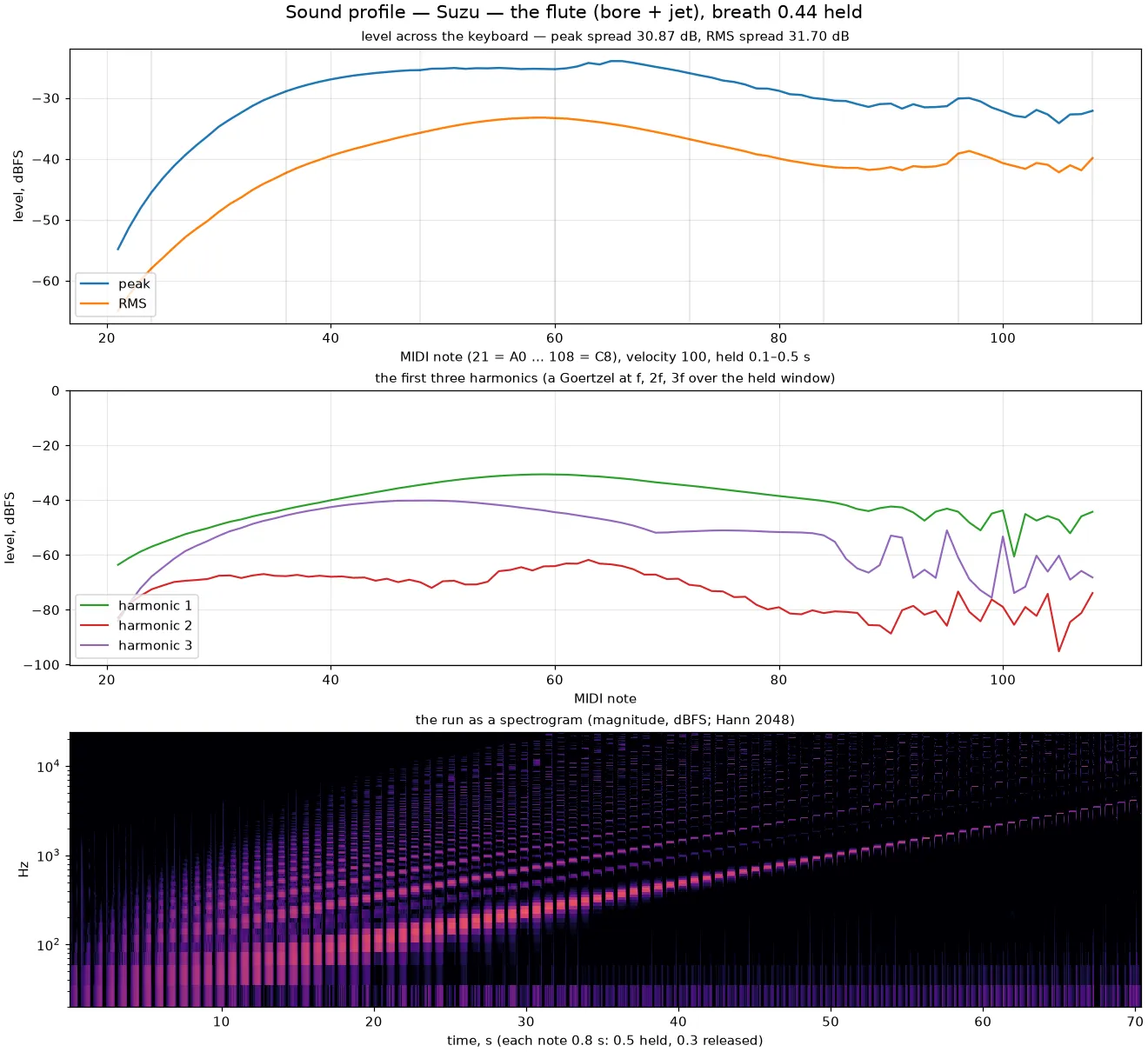
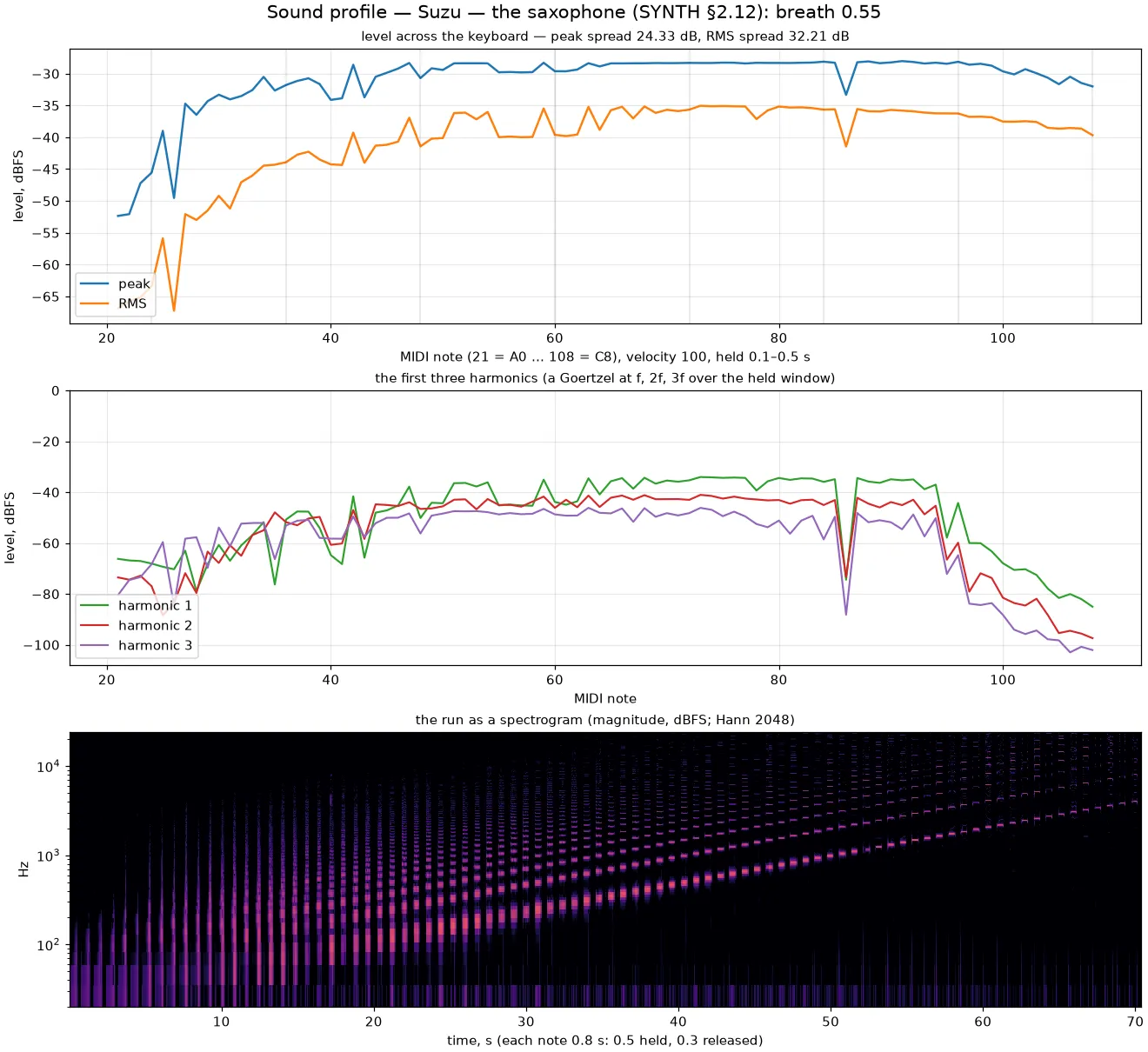
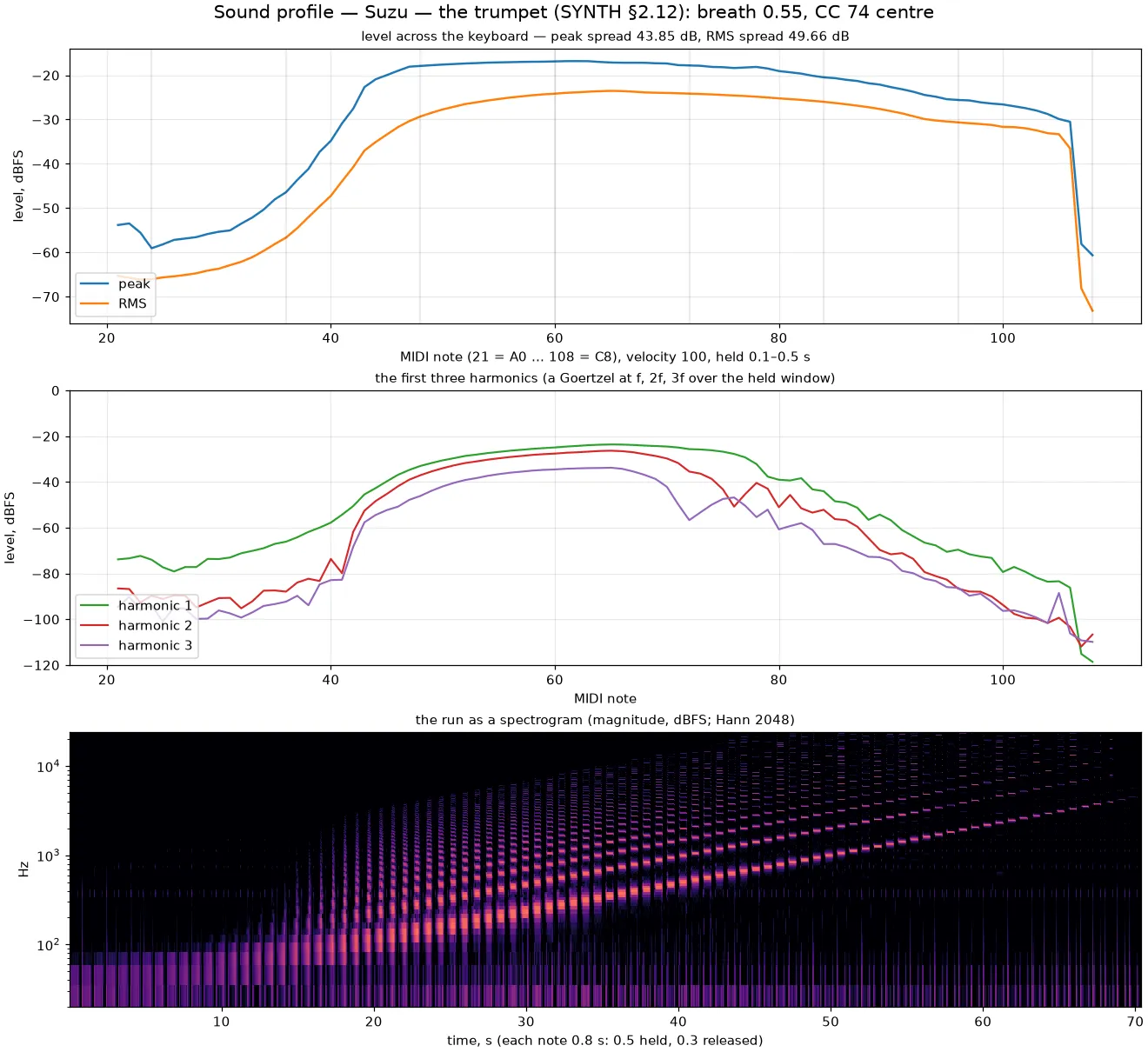
The flute at the reference breath (one breath sings C2 to C7 within eight decibels), the saxophone at breath 0.55 (C2 to C7 within six, the first register everywhere, the bore running out of cells below C2), and the trumpet (C3 to C6 within a decibel, the bass falling away below C3 where the bore wants three times the cells the cap allows — the trumpet’s range, as a trumpet’s is). The chapter: winds.
Fitted profiles (VCSL references)
Section titled “Fitted profiles (VCSL references)”Suzu’s instrument patches are fitted directly to real instrument samples from
the Versilian Community Sample Library (VCSL, CC0). Using tools/suzu_fingerprint.py,
the natural partial ratios, inharmonicity , strike weights , and decay
rates are measured across the keyboard, and mapped by least squares
(tools/suzu_fit.py) to Suzu preset blocks (presets/SCHEMA.md).
The side-by-side verification (tools/suzu_compare.py) compares the fitted
synth’s output against the sampled reference note by note: tracking the spectral
distance across the harmonics and the decay error. The evidence and profiles
are archived in docs/evidence/step67/suzu_vcsl/.
midi-sink 2.0.0-rc.5 · AGPL-3.0 · source