
Winds
The flute: a bore and a jet
Section titled “The flute: a bore and a jet”The first wind. The bore is the chain again, wearing acoustic variables: pressure at the nodes, volume velocity between them, the cross-section as a weight per node, the same symplectic Euler and the same stability ceiling — derived from the grid, gated at load, its red control archived. Pitch is the bore’s length: a note gets as many cells as its wavelength needs and the Courant number absorbs the fraction. Three geometries were measured against theory: a closed-open cylinder peaks at the odd harmonics, an open-open one at all integers, and a cone closed at its apex at all integers too — the saxophone’s series, the conical result, real. The ends are declared ports where the sound leaves, their loss rising with frequency as a real open pipe’s does; their reactance is an end correction, and the tuning counts it.
The jet has no moving parts. The air leaving the flue is carried by the acoustic displacement there, travels to the labium in a time set by the blowing pressure, grows on the way — best around one frequency that rises with the jet’s speed — and the labium splits the flow: inside or out, a tanh. The rate of that split is a pressure across the labium, and that pressure is the bore’s port. It can never do more work on the bore in a sample than the mouth does on the jet: the mouth-power ledger holds by arithmetic — the energy the bore holds stays under ∫P·Q dt, the jet’s stored energy ≤ 0.06 % of it over a phrase.
Breath is the mouth: CC 2, or the press when the patch lets it blow. No breath, no tone.
Nothing here is programmed to overblow. Raise the breath and the jet’s travel time shortens until the phase no longer favours the fundamental; the loop bifurcates to the octave on its own. Blow softly and the tone sits flat — the jet’s phase lag, for free.
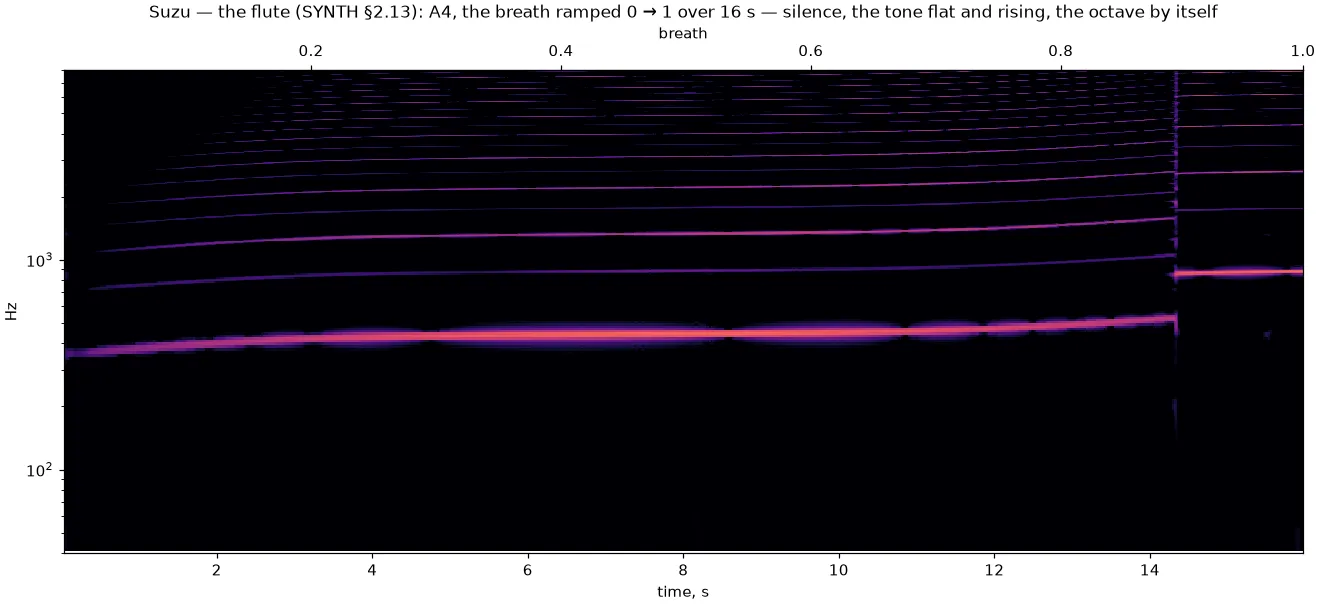
A4, the breath ramped 0 → 1 over sixteen seconds: silence, a flat whisper, the note, sharp, and the octave by itself — within 7 cents, on the desktop and in Chrome.
The saxophone and the trumpet: a reed and a pair of lips
Section titled “The saxophone and the trumpet: a reed and a pair of lips”The other two winds have a moving part. The valve is one cell — a mass on a spring under the pressure difference between the mouth and the mouthpiece — and the two instruments are the two ways it can face: the reed closes when the mouth pushes harder, the lips open. Air passes the aperture as Bernoulli says it must, as the square root of the pressure across it, and here is the hard part: the pressure across the aperture is the one the bore has after the flow arrives, so the flow is the root of a quadratic solved against the bore’s own one-step impedance, exactly, every sub-step. The naive alternative — take the pressure from the step before — is the archived red control: it runs finite on a steady blow and goes non-finite the moment a transient hits it. So the patch is probed when it loads, twice, with the bore’s losses zeroed and a retune halfway, and the mouth-power ledger is asserted: the energy in the bore and the valve together never exceeds the work the mouth has done (E ≤ 1.05·∫P·Q at 30 ms; the naive junction reads ×). The valve’s own swept volume and its own energy are in that sum; the ledger caught the sign of the first and the form of the second before a note was heard.
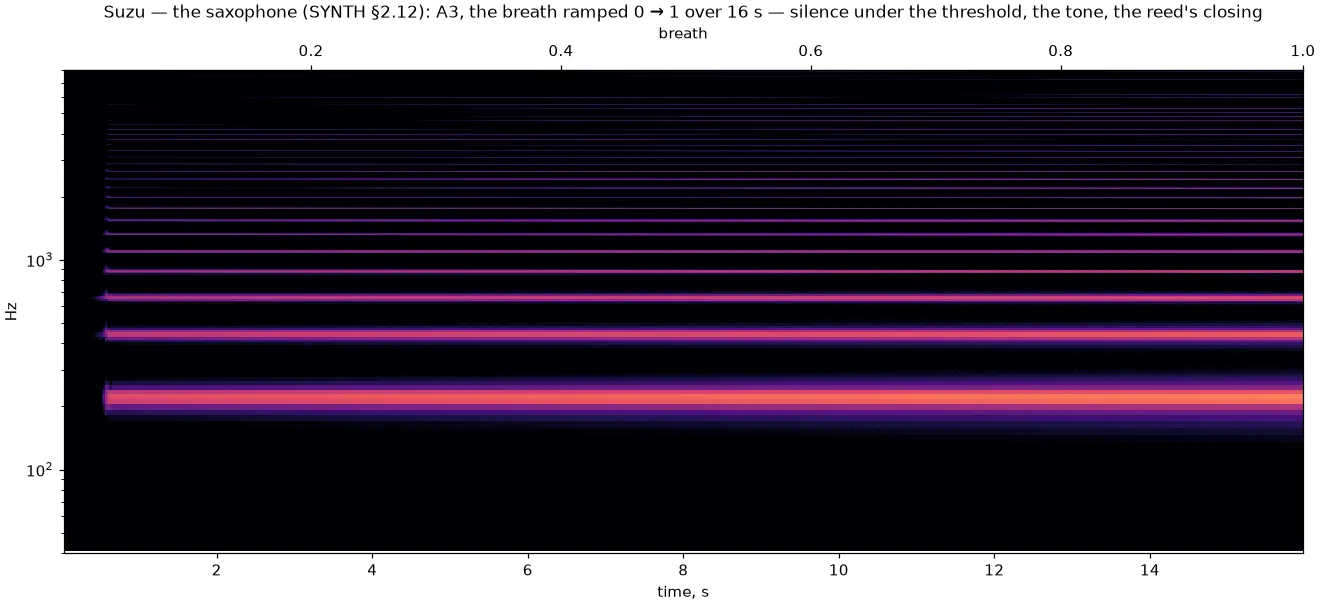
The saxophone is a cone closed at its truncated apex, and the truncation is where the instrument lives. A cone cut deeply has a weak first peak — the third is three times it — and a reed does what a reed does: it takes the strongest peak, and the sax played its third register with a slow modulation at the note that every pitch estimator read as a wandering fundamental. Cut at a quarter, with a mouthpiece holding the volume of the missing apex (Benade’s rule, which puts the peaks back on the integers), the first peak stands within a factor two of the second and the first register holds — on every note, because the sax scales with the note as the flute’s embouchure does: its bell’s cutoff and its wall loss are declared at A3 and follow the pitch, so C6 is the A3 horn in miniature. The reed is quasi-static, a stiffness with a stop at the lay. Its pull on the pitch is measured when the patch loads — four notes blown, the period of each against the note — and the bore is cut to cancel it. Breath is the mouth pressure, from the reed’s threshold at a light breath to six tenths of its closing pressure, and the level follows the breath — a beating reed’s own amplitude barely grows, so the crescendo is declared. The sax’s spectacle is that it does not overblow; A3 keeps a quasi-periodic beat in its tone, the author’s accepted character.
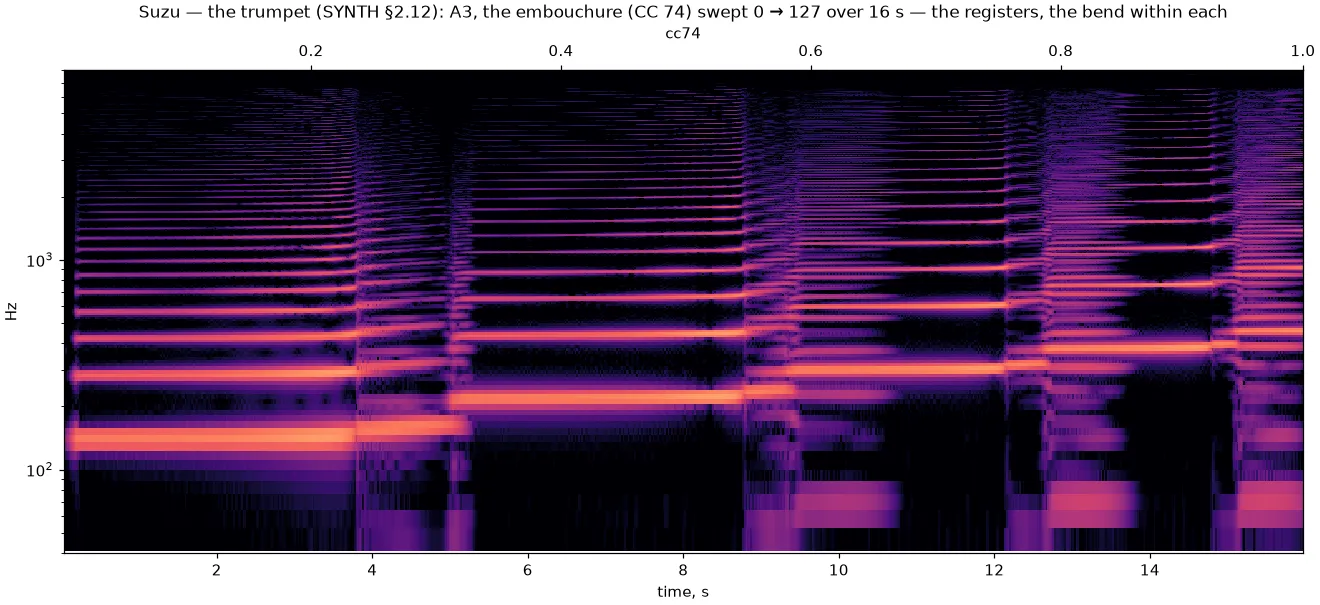
The trumpet is a cylinder with a flare, and its registers are the player’s lips. The note sits on the bore’s third peak — a flared bore’s peaks are not a harmonic series from its length, so they are measured when the patch loads — and the lips’ resonance sits just under it (an outward valve plays above its resonance). CC 74 is the embouchure: it bends the lips an octave either way, and the trumpet steps down to the peak below at one end and up to the octave at the other, bending within each register as the lips pull it — the staircase in the chart, with the pedal showing through where the lips cross between peaks. The brass is a declared shear on the outgoing wave at the bell, amplitude-driven; the shock itself stays deferred. On the tablets the Trumpet patch sounds under the trumpet layout’s valves, the engine’s own fingering choosing the partial and the lips following CC 74.
The profiles
Section titled “The profiles”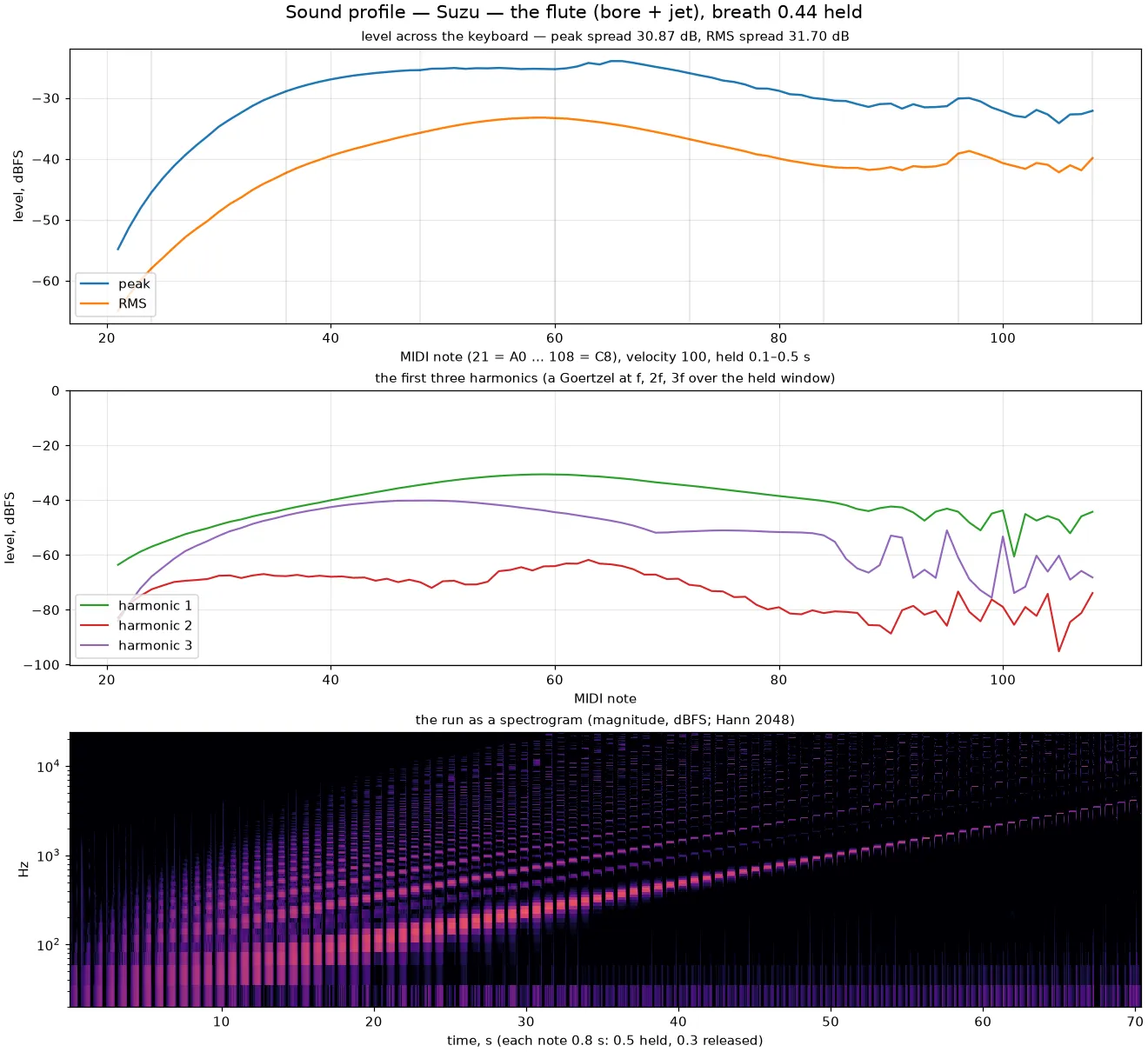
The flute at the reference breath (0.44) on every note: the embouchure follows the note (the jet’s delay in periods, its gain with the pitch, its width against it), so one breath sings the keyboard from C2 to C7 within eight decibels. The chiff is the jet’s noise filtered by the bore.
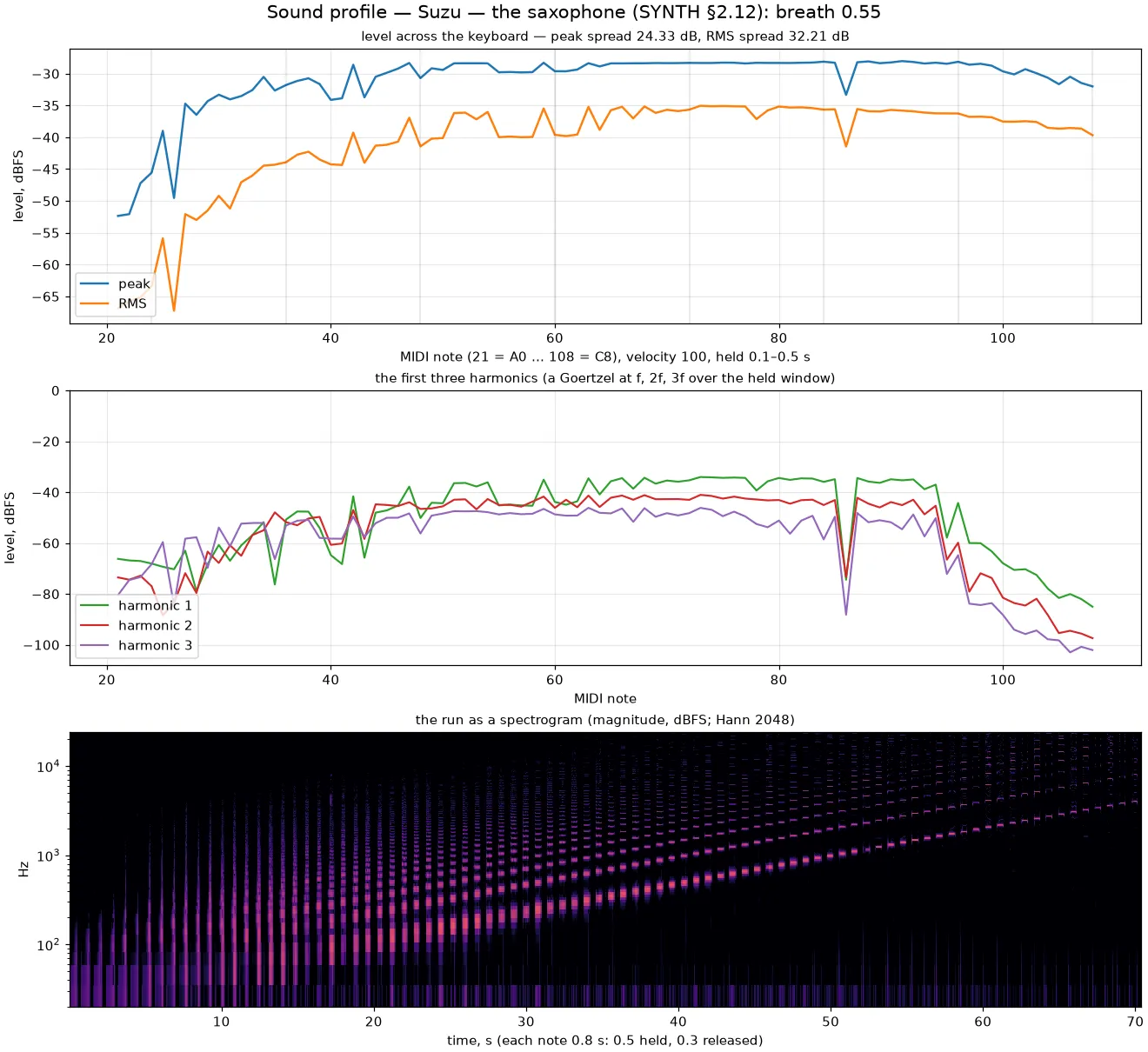
The saxophone at breath 0.55: C2 to C7 within six decibels at half breath, the first register everywhere. Below C2 the bore runs out of cells and the level thins: the sax’s range.
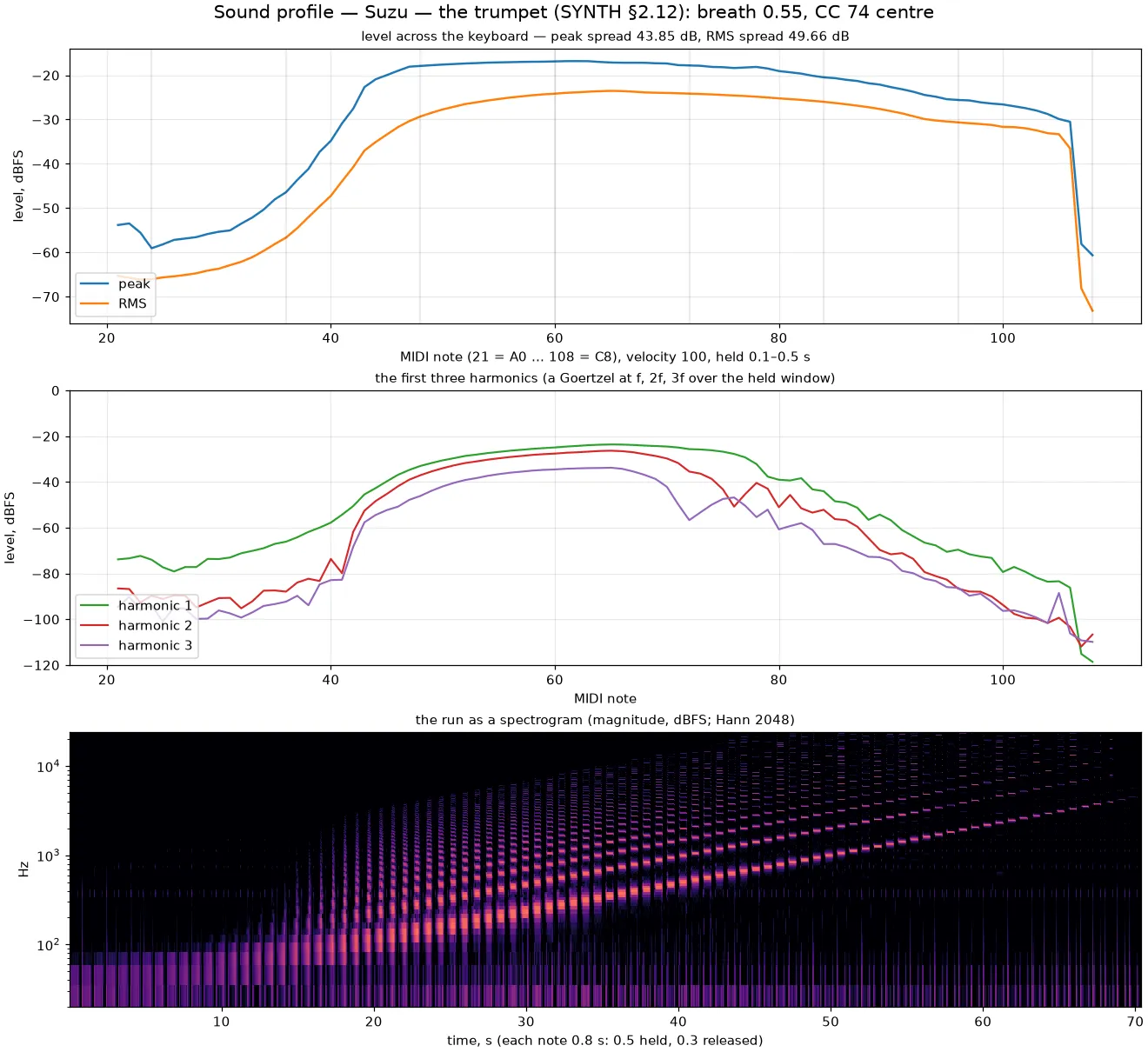
The trumpet at breath 0.55, CC 74 at centre: C3 to C6 within a decibel, C7 nine down. Below C3 the bore wants three times the cells the cap allows (its own fundamental is the note’s third) and the bass falls away — the trumpet’s range, as a trumpet’s is.
midi-sink 2.0.0-rc.5 · AGPL-3.0 · source