
Cells
The magic circle
Section titled “The magic circle”One cell is one rotation in phase space, and its orbit is the circle you see. Per sample,
This is the Gordon–Smith oscillator (1985; the “magic circle” of the synthesis folklore). The two half-steps are each a shear — each, together — and the quantity is conserved exactly, so the orbit keeps its size for ever: the oscillator is exact in pitch (within 0.000 cent across MIDI 21–108 at 44.1 k and 48 k, because is the exact rotation’s coefficient, not a Taylor series) and incapable of drift. A strike sets the orbit — , , the amplitude the velocity’s (0.25 at 127) — and the release is a declared contraction per sub-step, a T60 the patch names. The output is through an attack ramp (a mixer stage, not a map on the cell) and the press’s level.
The MPE correction. A glide retunes every frame; a retune alone would change the orbit’s size (the conserved quantity has in it), so the cell is re-based onto the new with its amplitude kept: ±48 semitones over two seconds costs 0.097 dB against the naive form’s 0.63 for a one-block jump.
The shears
Section titled “The shears”A shear of one coordinate by a function of the other is still symplectic: with a cubic bends the circle and the bend is the harmonics the spectrum shows arriving. A symplectic cubic is a gentle waveshaper — the third harmonic 33 dB under the fundamental at a shear of 0.3, 23 dB at full gain — and it detunes the cell; the cell calibrates the shear’s detune at start-up and compensates it, so every note stays within a fifth of a cent at full gain (the calibration within 0.19 cent for the cubic, 0.02 for the fold). The two shear kinds are the cubic and the fold; the hard timbres belong to the Duffing cell and the kicked rotor. The shears run in a 2× section; the fold’s sharper corners would want a 4× budget with a half-band filter, an open item carried rather than spent.
The filter
Section titled “The filter”The state-variable filter is the thematic form — the Chamberlin core at twice the rate, resonance — a declared dissipation: its is the one place in the cell where , and it is the same everywhere. CC 74 scales the cutoff by , three octaves either way about the patch’s. The exact tuning of the Chamberlin core holds for the undamped ring only; with damping the ring sits 2.3–2.5 cents sharp at C8 at , so the coefficient is solved per block for the damped ringing frequency in double precision — the ring within 0.008 cent across the keyboard.
Denormals, and the rest
Section titled “Denormals, and the rest”Sixty-four released voices’ tails stay flat to the end: this Apple CPU shows no denormal cliff with flush-to-zero off, and the x86 boxes have theirs to show. Sixteen cells with the filter and a shear take 3 % of the audio callback (0.09 ms worst of 2.67 at 128 frames and 48 k).
The profile
Section titled “The profile”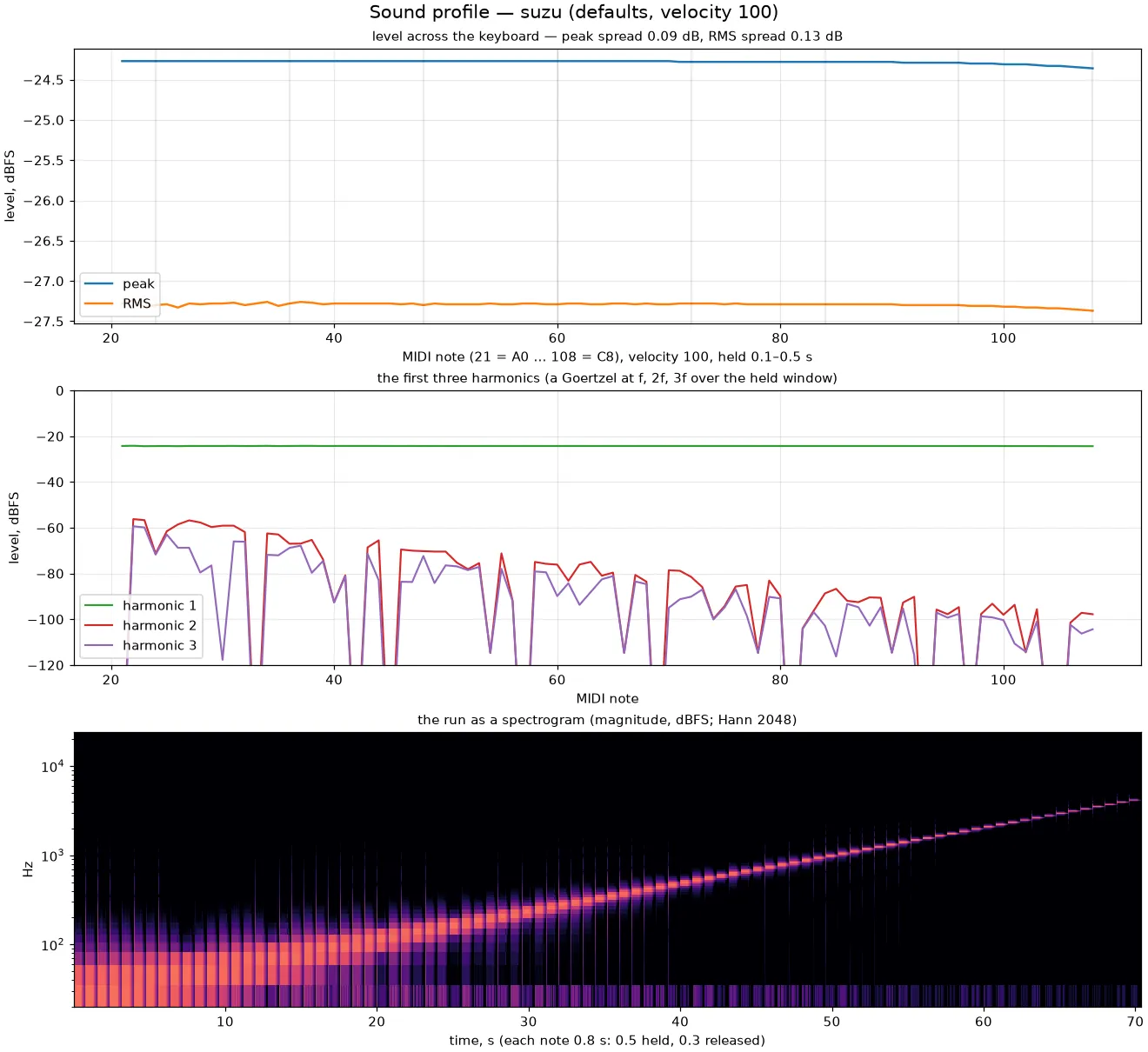
A magic-circle cell per voice: a pure sine at the same amplitude on every note — flat to a tenth of a decibel from A0 to C8 — with no harmonics (the faint second and third are the measurement’s own leakage). Every voice’s profile →
midi-sink 2.0.0-rc.5 · AGPL-3.0 · source