
The modal voice and the breath bow
A voice is a chain of cells
Section titled “A voice is a chain of cells”A Suzu voice is up to sixteen magic-circle cells, each tuned to a ratio of the note — the placed partials — each with a decay it declares, and coupled to its neighbours by a spring in phase space. Every sample does three things, in this order: the coupling kick, computed from where every cell was before the sample began; each cell’s own rotation; the declared damping. Each stage is symplectic, so the chain as a whole neither makes nor loses energy on its own: a bell with every decay set to zero, struck once, rings for ten minutes within two thousandths of a decibel.
Partials, harmonics, overtones. Partials are whatever frequencies a voice contains; harmonics are the integer-ratio ones; overtones are the partials above the fundamental. Here partials arise in exactly three ways: placed by a preset’s ratios, created by the phase-space shears (the cells chapter), and split by coupling.
The presets
Section titled “The presets”| preset | ratios | strike weights | what it is | fitted to (VCSL) |
|---|---|---|---|---|
| harmonic string | a string; its stiffness (0 for nylon) | Concert Harp, acoustic guitars | ||
| stiff bar | — 1, 2.78, 5.44, 9 … | a free bar | Glockenspiel, marimba, vibraphone | |
| bell | 0.5, 1, 1.2, 1.5, 2, 2.5, 2.667, 3 … | as cast, the prime loudest | hum, prime, tierce, quint, nominal … | Tubular Bells 1 & 2, hand bells |
| glass | 1, 2.32, 4.25, 6.63 … | a struck glass | Crotales, glass | |
| plucked string | Karplus–Strong in modal form; the pluck position | Dan Tranh (zither), Concert Harp |
The decays follow the string’s law: the fundamental’s T60 is the patch’s, and each partial above dies faster by a rate that grows with its ratio squared — highs first. The plucked string’s weights are the triangular pluck’s spectrum in closed form: pluck near the bridge and the strike brightens; pluck at the middle and the even partials are not fed at all.
Coupling, and why it had to be compensated
Section titled “Coupling, and why it had to be compensated”The spring between neighbours is a shared potential, so energy migrates between partials — the physical origin of a soundboard’s richness — and the swirl dimension (poly pressure) adds to it: pull down and hear the overtones stir. But a spring stiffens each mode it touches. The first lattice played its fundamental 149 cents sharp at the default coupling with the swirl down: the coupling knob was a pitch knob before it was a timbre knob.
So the coupled chain is solved at patch load — its normal modes found, and each cell’s own stiffness adjusted until every normal mode lands on its ratio — and the voice runs on that, tabled over the coupling’s range and corrected for the pitch it is playing. The partials stay where the preset put them to a tenth of a cent from C2 to C8 at any coupling the gate admits, and what remains of the coupling is the exchange of energy. Splitting survives where it belongs: two cells at the same pitch split into a close beating pair, exactly the joint map’s normal modes.
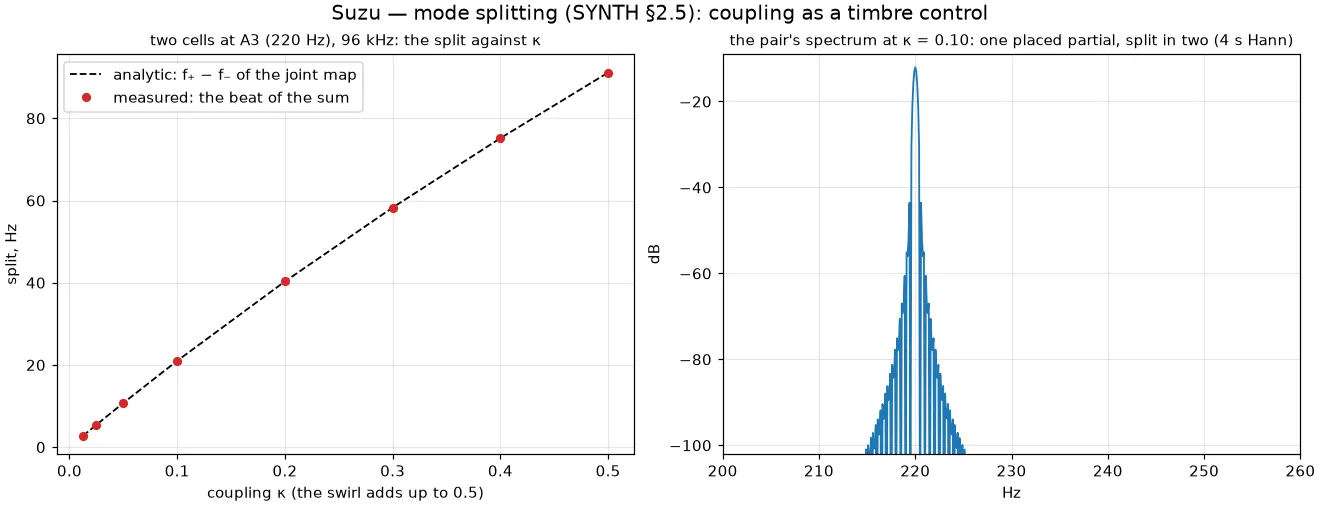
Two cells at the same pitch, coupled, split into a close pair and the sum beats at their difference. The measured beat sits on the analytic line to a hundredth of a percent from κ = 0.0125 to 0.5.
The load gate
Section titled “The load gate”A patch is refused at load, with a message, on either of two counts: the coupling would take a partial’s whole spring (the compensation cannot place it), or the chain’s stiffness would reach the sampling bound somewhere in the playable range — every semitone from A0 to a C8 bent up four octaves, the modes past the output’s Nyquist muted as the voice mutes them. For every shipped preset the first count binds first; the second is the chain’s ceiling, and its red control lives on two cells just under that ceiling: five percent over the bound and the harness blows up at once, five percent under and it rings.
The breath bow
Section titled “The breath bow”A cell’s damping can be signed: below a target orbit the cell is anti-damped — the bow grips — and above it damped — the bow slips. The composite is a limit cycle by construction, never free growth: from silence and from twice the target the orbit settles alike, within a few time constants, and with no breath there is no bow — the declared decays alone, and silence is a gated property.
Breath (CC 2, or CC 11) sets the target; the bow’s onset sets its time constant — slow blooms, fast speaks at once — and a bow position says which partials it feeds. One consequence of the servo’s honesty: it can only inject energy as fast as its onset allows, so a partial whose own decay is faster than that cannot be held — it rings from the strike and dies. At the defaults the first three partials of the harmonic string sing; shorten the onset and more join.
This is the wind player’s reason to be here: the instruments that breathe finally have a voice that holds. On the tablets the Bowed string patch is this voice under the brass layouts’ valves and slide.
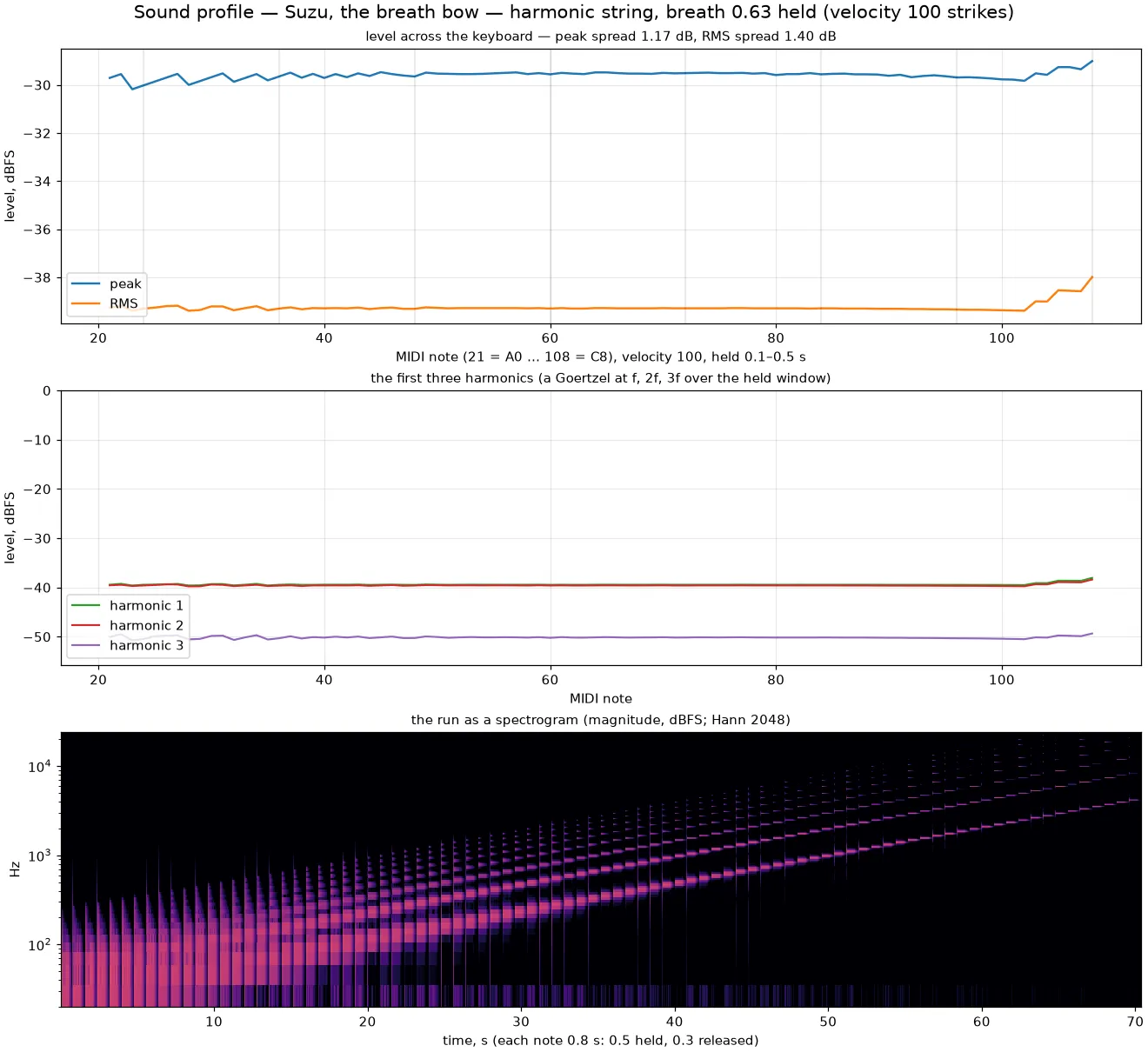
The harmonic string with breath 0.63 held through every strike: a flat singing line across the keyboard, the second partial level with the first at bow position 0.3.
The profiles
Section titled “The profiles”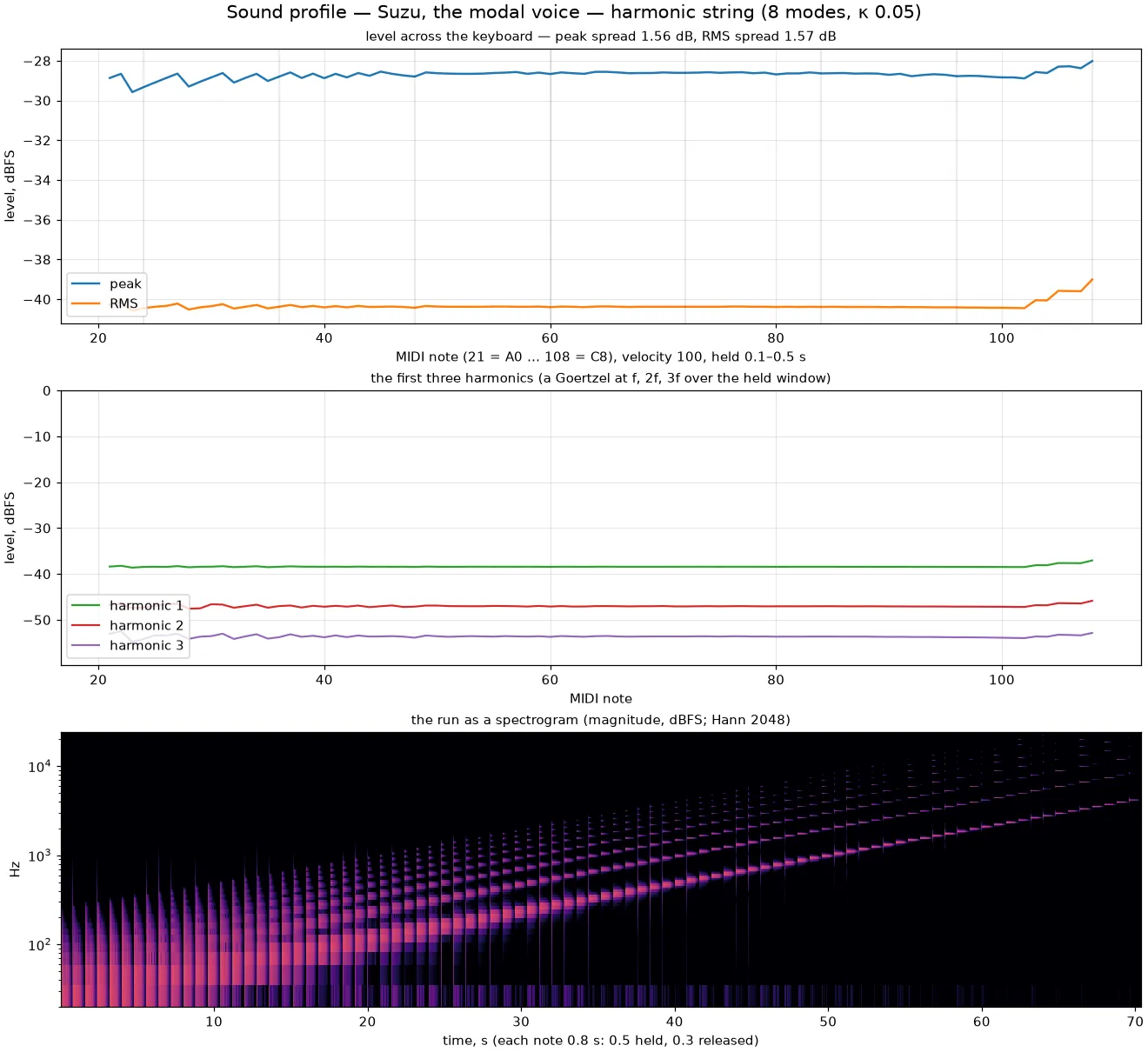
The harmonic string: partials at 1, 2, 3 … with weights , the highs decaying first. Above C7 the upper partials cross the 24 kHz ceiling and are muted — fewer partials, a little less held energy, and the level line bends by a decibel.
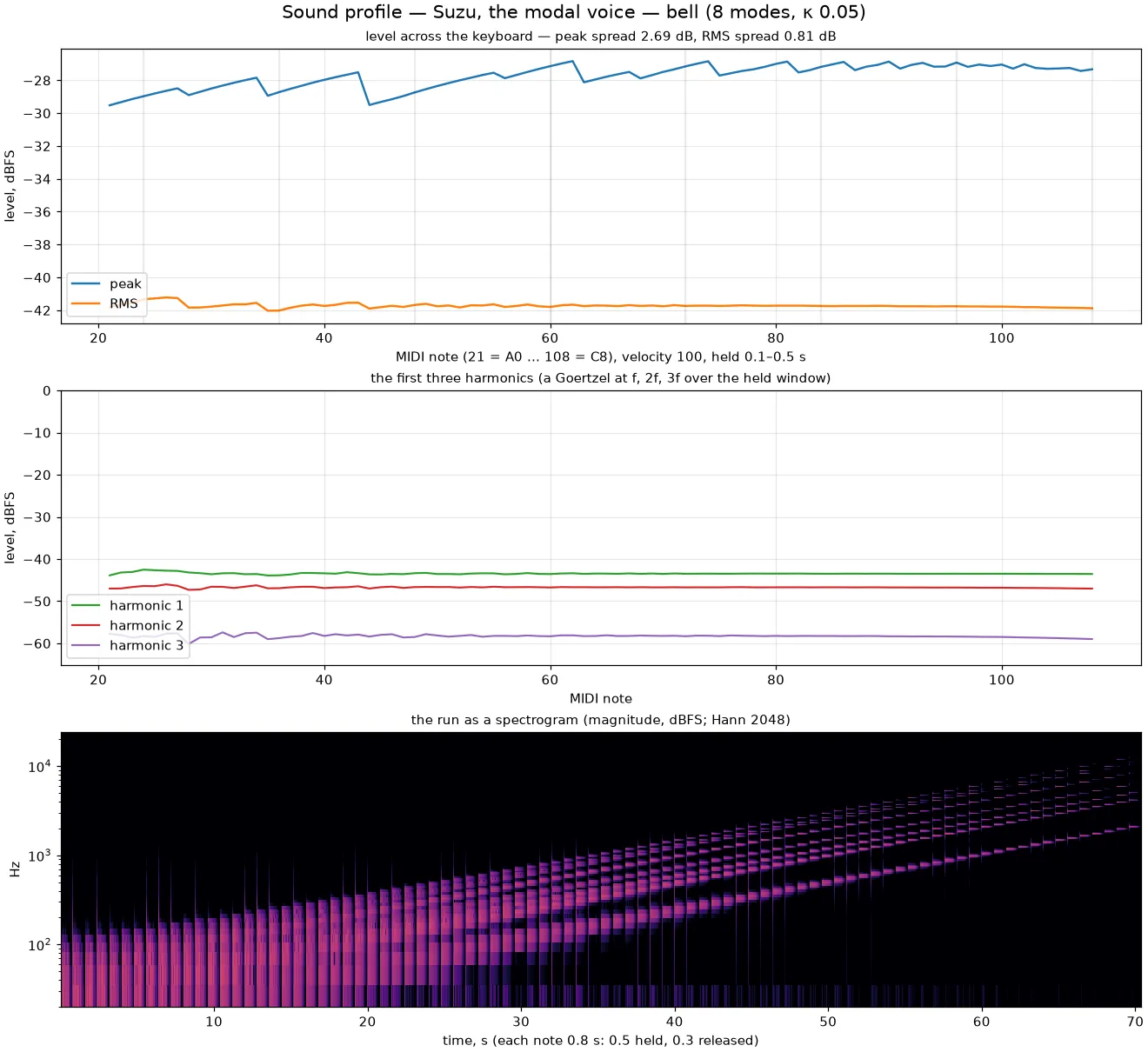
The bell: the hum an octave under the prime, the tierce, the quint, the nominal and the cluster above. The peak line’s sawtooth is the measurement’s — a 0.4 s window catches the prime–tierce beat at a different phase on each note; the RMS underneath is flat to 0.8 dB. The bar, the glass and the plucked string are on the profiles page.
midi-sink 2.0.0-rc.5 · AGPL-3.0 · source