
The orbit trace
Every Suzu voice is a state moving in a plane: a cell’s , a lattice’s sum, the rotor’s momentum on its torus, and for the strings and the winds — whose state is a whole chain — the sound against its own slope, the phase plane of the note. The orbit trace makes that motion visible, two ways, from the actual trajectory and nothing else.
The ink route (the one that marbles)
Section titled “The ink route (the one that marbles)”Each video frame, the shell asks the synth for what each traced voice has drawn since the last frame — the last few milliseconds of orbit, decimated to a handful of segments by curvature, so the bends get the vertices and a straight run gets few — and lays it into the water at the note’s cell as tine segments (or wake segments, the stylus doublet), scaled by the orbit’s amplitude. A pure sine stirs a small circle. A shear-distorted orbit combs its harmonics into the ink. The kicked rotor past its threshold scribbles. The segments are budgeted like any feed — twenty-four a frame over all voices, the overflow merged within each voice, never one voice dropped while another draws — and with the trace off the water is bit-identical to a world where the trace never existed. The route is the gesture ABI, so a replay carries the segments as it carries a pen stroke, and the live trace stays out while a recording plays.
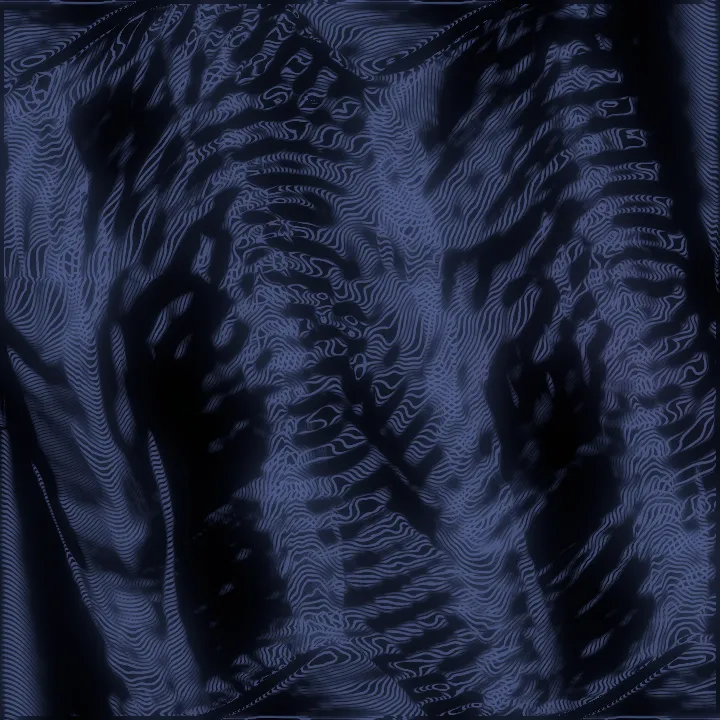
The kicked rotor, four voices held in Anod while the wheel sweeps K to 2.5: its orbits inked as tines at their cells — the synth drawing its own phase portrait.
The scope (the cheap sibling)
Section titled “The scope (the cheap sibling)”The same orbits drawn live, at their cells: on a miniature of the canvas in the desktop’s Sound section, held voices bright and released ones dim; and on the canvas itself, screen-locked in amber over the water — or alone on the scope’s dark glass with the water hidden, the synth’s phase portraits and nothing else, while the water underneath keeps marbling. It is a live-composite pass, the one core touch of the phase: non-destructive, and nothing the dip, the print or the export sees.
The knobs
Section titled “The knobs”In the desktop’s Suzu trace section, the settings file and the preset: a switch for each route (ink, scope), this voice kind (per kind — the rotor traces by default), the scale in canvas heights per unit amplitude (a cell’s amplitude is the level: 0.25 at velocity 127), four to eight segments a voice a frame, the stroke (tine, exact; wake, sub-stepped), and on the canvas: off, over the water, or the scope alone.
On the tablets the Sound page carries the two routes under Synth trace whenever the synth is the source: Draw the orbits into the water (off by default — on, every synth note stirs the water at its cell) and Scope on the canvas (off, over the water, alone), with Trace scale — the desktop’s knob: 0.25 draws the rotor well, the modal voices and the winds, whose orbits are smaller, want more. Every voice kind is traced there; the patch picks what sounds. The bridge is the same code on the three shells, a library beside the presets and the replay, and a tablet’s recording carries its ink segments as the desktop’s does.
The Suzu lab draws these portraits as well, from the same ring read at full density, one point every sub-step.
midi-sink 2.0.0-rc.5 · AGPL-3.0 · source