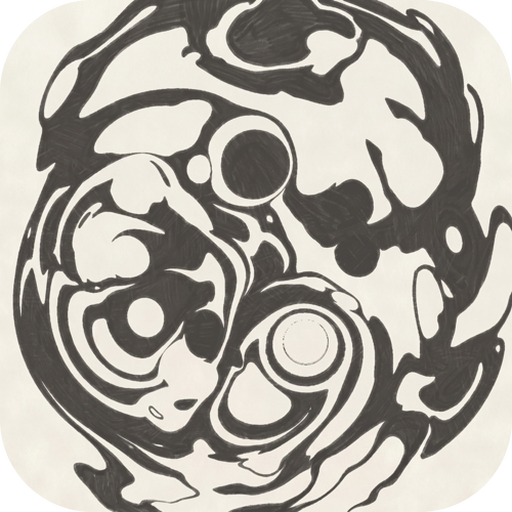
Braid
Lineage. The vortex is Lamb–Oseen’s, as on the swirl page; the chord’s flow is Kirchhoff’s point-vortex system, whose Hamiltonian the free mode integrates; the splitting is Strang’s; the consonance is Sethares’ reading of Plomp and Levelt’s roughness.
What it does. Under Kessho (or bend_mode 5 anywhere) a chord is a vortex
system. The lowest held note is the bass; every other voice’s interval against
it, bend included, is read on a consonance curve — Sethares’
sensory dissonance over the first six partials, anchored at the unison
(), the tritone () and the minor second (); at C4 the fifth reads
, the fourth , the major third about zero, the octave .
The circulation is
the bass taking with the positive sign, the floor made continuous through so a bend through the tritone flips the sign without a jump; the Braid couple control scales the others’ circulations. Same-sign pairs co-rotate and braid about a hyperbolic point between them; opposite-sign pairs are a dipole and jet, carrying their ink.
Never integrated. The ink is advected by the superposed flow , but no flow is solved: each frame the existing exact swirl passes — one per voice with the half-circulation — are composed in Strang order, then . That is a second-order splitting of the superposed flow in which every factor is a rotation, so the composition has exactly; the saddle and the cat’s-eye separatrix emerge in the composed field. Fifteen voices are thirty passes, within the budget of sixty-four. The sequence at is its exact inverse, which is what the soak’s pairs use.
Pinned or free. Pinned (the default), the vortices stay at their keys and the ink braids and jets between them. Free, the vortices themselves move under each other’s flow: Kirchhoff’s point vortices under , stepped by the implicit midpoint rule — symplectic, keeping the centre of vorticity and the angular impulse exactly and to a few parts in a billion over ten minutes — so consonant notes orbit each other and dissonant ones travel as a pair, carrying their ink. A note re-anchors at its key when struck; a lifted note’s vortex fades over a quarter second and goes on its way; the sheet’s edges hold the vortices five percent in. The two are the A/B item B-1, both built, decided by viewing.
Ownership
Section titled “Ownership”- Per-note bend under Kessho’s default table (
bend_mode5; the Braid consonance choice in the settings): the drop holds, the bend moves the interval and so the circulation. The Braid couple control (CC) scales the non-bass circulations; Braid vortices in the settings picks pinned or free. - No gesture of its own:
sumi_add_vortexalready composes.
In the bench
Section titled “In the bench”--braid-test: the passes and the frame time at fifteen voices, the fifth’s
saddle and elliptic cores, the minor second’s jet, the bend from the second
to the fifth flipping the one into the other; --soak braid the four-part
gate; --ab braid --ab-out <dir> the pinned and the free renders of one
chord in Sumi and Kessho; the headless suite the curve, the records and the
free vortices’ invariants.
midi-sink 2.0.0 · AGPL-3.0 · source