The billiard
The flight and the wall
Section titled “The flight and the wall”The state is a position in the wall’s units and a velocity in the cell’s, and between the walls the particle is the note’s oscillator in two dimensions: each plane turns by a step, the exact rotation as three shears, at four times the output rate. The wall is a stadium — two half-ellipses, their aspect on CC 74, joined by straight walls whose length the mod wheel sets. A step that would cross the wall is cut at the crossing: the fraction of the rotation found by sixteen bisections on the angle, the velocity reflected off the wall’s normal, , the rest of the rotation taken. Rotations and reflections: the map has on the four-dimensional state, Liouville’s theorem, and the suite reads the energy across sixty-six thousand collisions in a lossless minute at dB. (The proposal’s was the two-dimensional impact oscillator’s, a different voice.)
The fold
Section titled “The fold”The kick is the drive times the velocity gain, in units of the wall, along the cell’s position by the equal-power pan law — at the centre a radial orbit on the circle, both channels the same bits. Under one wall-width the voice is a sine at the note; past it the orbit folds, and the fold raises the pitch: a radial orbit kicked past the wall bounces at
times the note — 2.58× at , measured within a hundredth of a percent — as a ball bounces faster in a bowl with walls, and the note returns as the orbit decays under the wall. The default drive puts the wall at mezzo-forte with the fold above it. The circle’s orbits are integrable, the wavefolder’s harmonics; pull the walls out with the wheel and the stadium’s orbits are ergodic — the grit, with left and right no longer the same.
The kink
Section titled “The kink”A reflection jumps the velocity, so the positions carry a slope discontinuity that sampling at 192 kHz would alias. Each collision adds the two-point polyBLAMP residual of its slope jump at its fraction of the step — to the sample before, to the sample after — through a one-sample output delay. The off-grid residual of the circle’s periodic orbit in the top octave is −80.5 dB of the fundamental over A3..A5, against the roadmap’s −60. The lab’s red is the reflection at the step’s end: it does not alias — a sample-periodic orbit aliases onto its own grid — but the bounce is quantised to whole steps, 3.8 % off the geometry where the exact path is within a hundredth of a percent.
The strobe
Section titled “The strobe”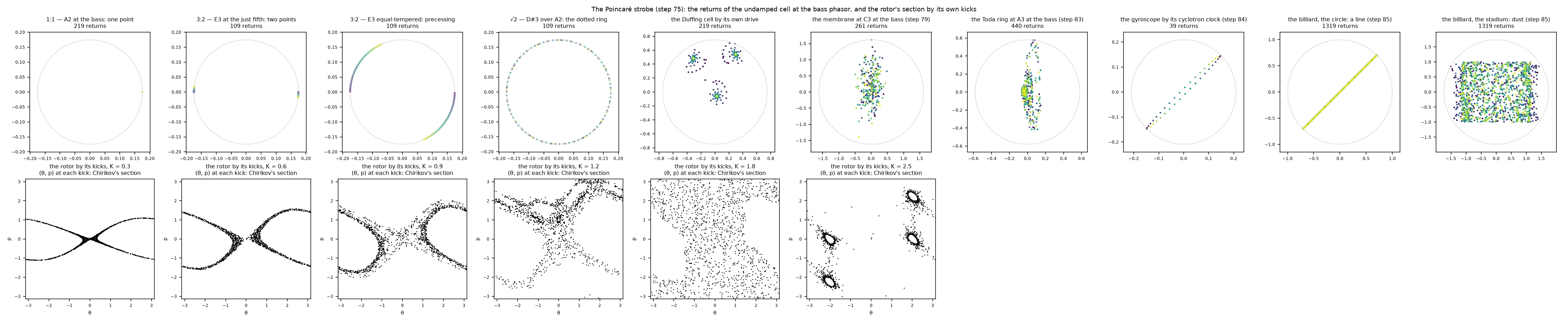
At the bass the circle’s radial orbit returns to a line — twenty-four of a
576-cell grid along the diagonal; a kick from the centre has no angular
momentum, so the circle’s section is a segment, not the roadmap’s ring, which
wants a strike away from the centre — and the stadium’s to dust, 153 cells,
the ergodic section.
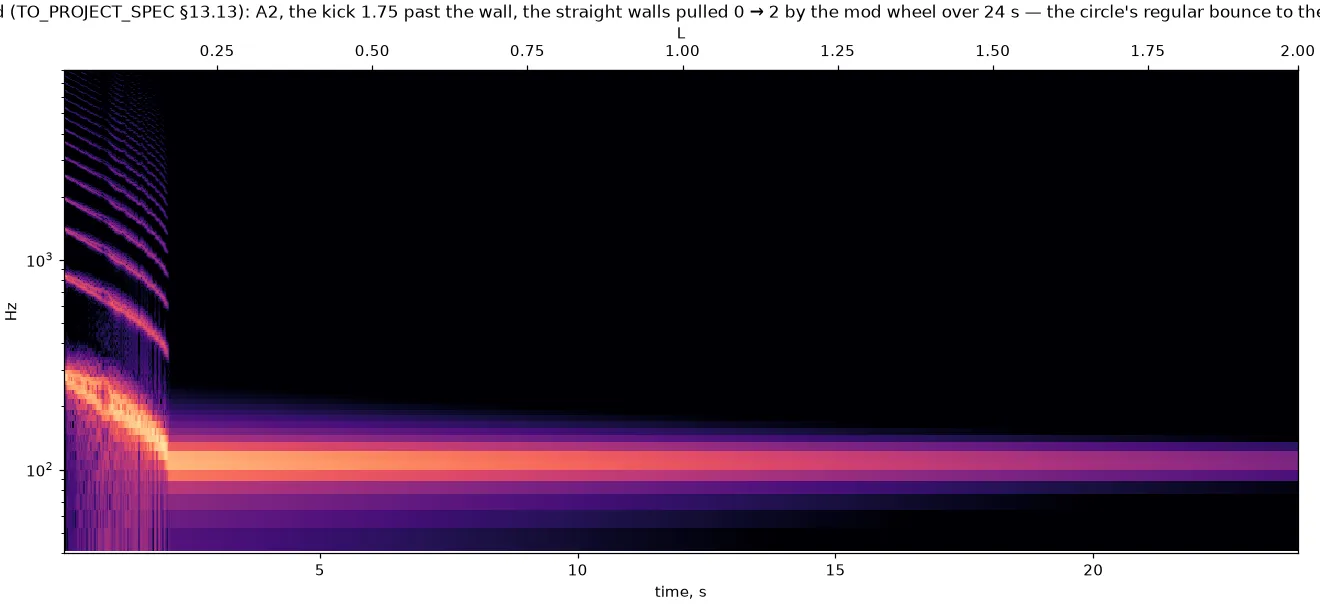
The bench’s --voxo-chart writes the sweep, the wheel pulling the walls from
the circle to the stadium over twenty-four seconds:
The profile
Section titled “The profile”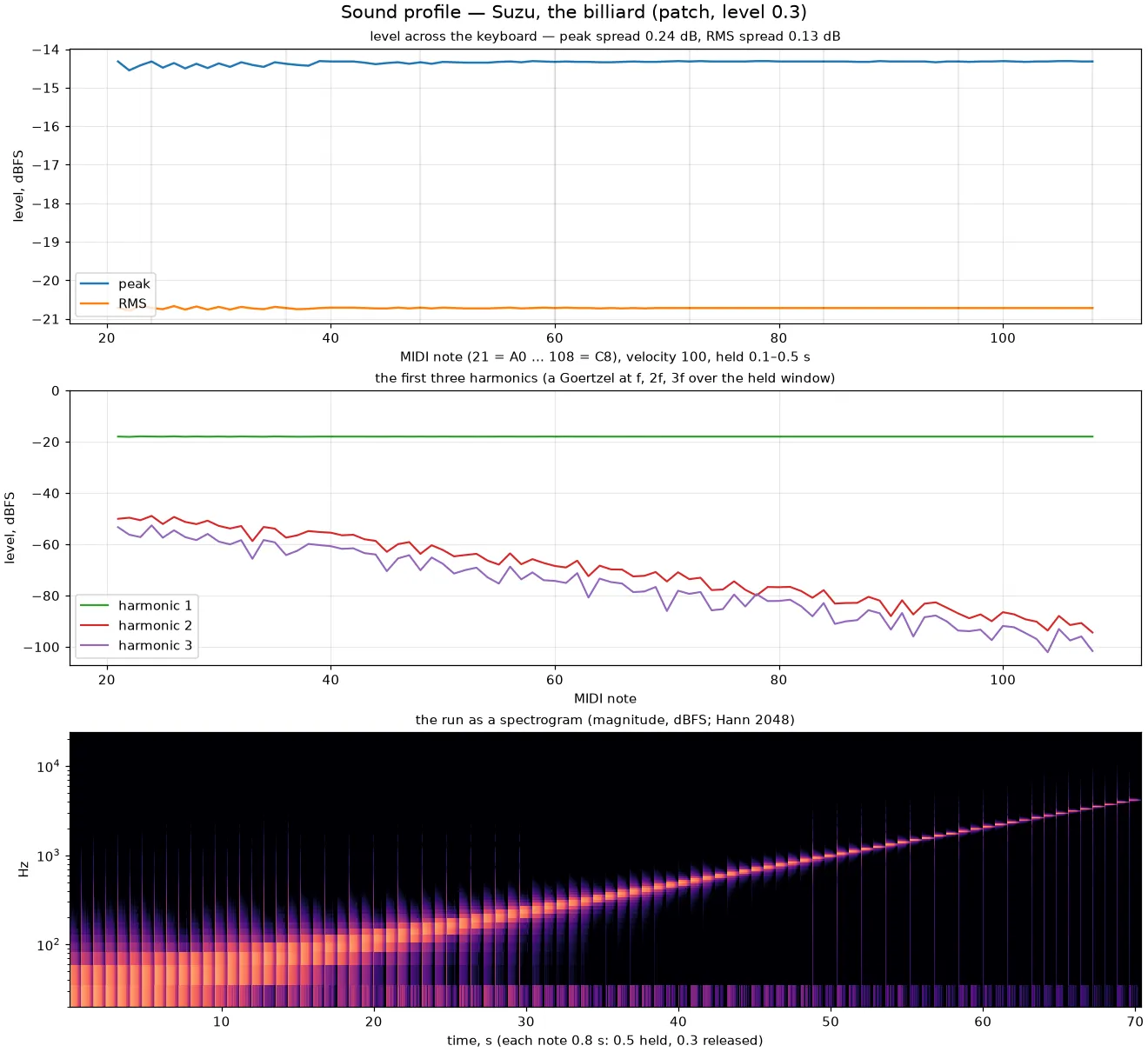
Billiard (stadium) is the twenty-first patch of the table, a little stadium at rest and the wheel to the full one; the desktop’s Sound section carries the drive, the aspect, the two lengths, the decay and the pluck as the kick’s pan; a preset file carries the four fields.
midi-sink 2.0.0 · AGPL-3.0 · source