
The Dirac network
The structure
Section titled “The structure”Write any lossless network of springs, masses and their couplings as
with the energy’s weights (the springs’ stiffnesses, the masses’ inverse masses), the Dirac structure that says which port’s effort drives which flow, and the dissipation. That is the port-Hamiltonian form, and it composes: two networks joined at a port are a larger . Suzu’s network keeps diagonal by choosing its states well — the springs’ extensions and the masses’ momenta rather than positions — so that is the chain’s incidence matrix and nothing more.
The step is the Cayley transform, the implicit midpoint rule in closed form:
built once at the strike by Gauss–Jordan and applied as one dense product a sub-step. With the step is Q-orthogonal — an isometry in the energy norm, conserved exactly — and not orthogonal, as the roadmap’s gate delta says; with it is strictly passive. The suite does not take that on faith: at every build the engine reads the step’s gain in the energy norm, the largest singular value of by power iteration, and reports it in the inspection. Over twelve random skew of six to sixteen states, at a step fifty times the engine’s, the gain is one to lossless and under one damped. The state and are double: a matrix that is Q-orthogonal to float’s last place is a gain or a loss of that every step.
The prepared network
Section titled “The prepared network”The patch routes energy between four things, as the proposal asked. A chain of masses on springs with both ends held — its lowest mode put on the note with the bridge’s loading counted, by inverse iteration on the chain-and-bridge stiffness inside a secant on the spring, the target prewarped for the midpoint rule: −0.2 cents at A3. A bridge mass on the chain’s last spring, with its own spring to the wall and its own loss — the radiation; the voice is the force the string puts on it, a saddle pickup. The bridge sits in the playing range by default, a body whose mode dips the plucked keyboard ten decibels where the string’s partials meet it; raise it above the range and the keyboard flattens but the bow stops singing — the bow is this patch’s voice, so the body stays. The stick-slip bow of the strings’ chapter on one of the masses, as a port: between Cayley steps the bow’s force is a kick on that mass’s momentum, solved against the friction curve with the bound, and its work goes in the ledger — at the network’s own scale, since the chain’s force threw the mass to the bow’s speed every sub-step. And the rattle stop: a wall a short way under the bridge’s rest, in units of the pluck’s static deflection; when the bridge reaches it the bridge is held there and its momentum reflected with the declared loss, as the reed hits its lay. Under the bow the bridge rattles on it hundreds of times a second — the preparation.
The ledger is the point. Lossless, after four seconds under the bow with the stop engaged 632 times, the energy held plus the stop’s losses minus the bow’s gain equals the strike’s energy to a millionth; the gain — the force at the synchronised velocity — never exceeds the bow’s work at its own speed, the difference being the friction’s heat. No feedback runaway, by arithmetic rather than by a limiter.
The level
Section titled “The level”The chain’s impedance rises with the note, so a flat kick would tilt the keyboard six decibels an octave; the pluck’s kick and the bow’s reference scale with the note instead, and the plucked profile reads fourteen decibels of spread over seven octaves, the body’s dip, down from thirty-nine.
What it costs
Section titled “What it costs”Eight masses are nineteen states: a 19 × 19 double product a sub-step, 0.8 % of a core a voice. The build at the strike is a 19 × 38 elimination and sixty tridiagonal solves — nothing.
The profile
Section titled “The profile”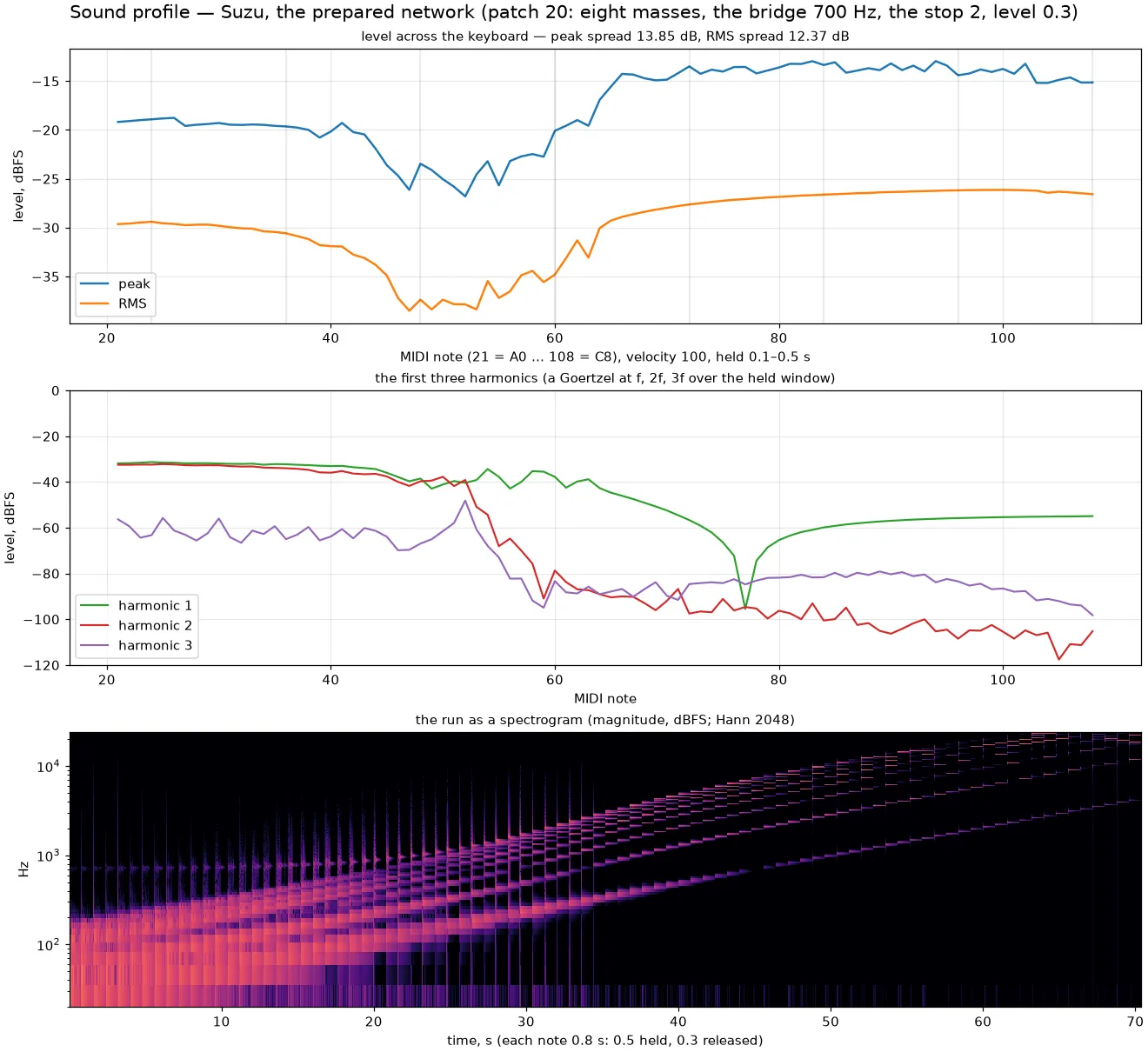
Prepared network is the twentieth patch of the table; the desktop’s Sound section carries the masses, the bridge, its decay, the stop and the bow’s rows; a preset file carries the six fields.
midi-sink 2.0.0 · AGPL-3.0 · source