
The Toda ring
The ring
Section titled “The ring”Take equal masses on a closed ring, and join each to the next by a spring whose force is not linear but exponential in the compression:
That is the Toda lattice, and it is the one nonlinear chain that is exactly integrable: pulses on it travel as solitons — localised compressions that keep their shape, outrun the sound speed, and pass through each other with nothing but a phase shift. Near the spring is linear with stiffness ; compressed, it stiffens as ; stretched, it goes slack. The parameter is the whole character of the voice. At the ring is a plain mass–spring loop, and its modes are the lattice’s,
an inharmonic series that flattens toward the top — a marimba bar’s kind of spectrum, with the fundamental set on the note exactly (the engine solves , the leapfrog’s own frequency, so the suite reads mode 1 on A3 within a hundredth of a cent and modes 2–5 on their ratios within a hundredth of a percent). At large the strike’s pulse self-focuses: the exact Toda soliton is
its amplitude fixing its width and its speed times the sound speed. The ring does not tune a soliton’s pitch; the pulse train’s rate at the pickup is the soliton’s lap time, and it rises with the press — at A3 under full press the fundamental sits 427 cents above the note, with the fifth harmonic eleven decibels under it: a clavinet’s pulse, from the same strike that a light press rings like a bar.
The press and CC 74 above centre set the nonlinearity, , so the voice goes from the linear ring to the train under the finger. The strike is a Gaussian compression of toda_width nodes at the cell’s position, mean-free around the ring (its length is fixed), launched to the right with — exact for the linear wave; the soliton outruns it and the rest radiates. Its amplitude is the level times the velocity, in strain units, and the output divides the same back: the level is the strike’s strength — a louder patch presses the ring harder and gets more soliton, as the Duffing cell and the membrane do.
The step, in double
Section titled “The step, in double”The ring is advanced by the kick-then-drift leapfrog — the momenta take the
force from the present positions, then the positions take the momenta —
twice a sub-step at the ×4 rate of step 78, each reading through the first
half-band stage, the second stage down to the output rate. Its state is
double, alone among Suzu’s voices: the gate below asks a thousandth of a
decibel over ten minutes, and in float the rounding of
at 192 kHz walked the energy a hundredth of a decibel a minute. Sixteen to
sixty-four nodes pay for it easily — a voice costs about 1 % of a core at A2.
The exponential is the ring’s own: a range reduction and a degree-eleven
polynomial, exact to double’s precision, plain arithmetic the compiler
spreads across the nodes and the same bits on every platform — the C
library’s exp was a whole tablet’s budget.
The leapfrog conserves a modified Hamiltonian, not and not the Toda lattice’s Lax invariants: the discrete ring is near-integrable. That is what the gates measure. Ten minutes of 192 kHz steps, lossless, at full nonlinearity: the mean of over each minute drifts 0.000017 dB from the first minute, while itself breathes ±0.06 dB under it with no trend; the biggest soliton — the struck pulse of 0.76 self-focused to 0.97, 1.83, a width of half a node — holds its amplitude within 0.26 % and its amplitude × profile width within 0.72 %; stays at . The roadmap’s 2 % and 0.001 dB are met with room.
The resolution rule
Section titled “The resolution rule”A fortissimo C7 found the ring’s real bound. The membrane’s kind of bound — the local stiffness under the leapfrog’s — was in place and the ring blew up anyway. On the ring alone the cause measured cleanly: the leapfrog resolves the exponential along the trajectory only while a step’s displacement over the exponential’s length,
stays small — past about 0.5 uncapped, and past 0.22 with the cap engaged, the integrator makes energy by the tens of decibels a second, whatever the cap’s shape. So the ring’s rate follows the pulse: two, four, six or eight inner steps a sub-step, chosen every block from the present peak and to hold under 0.15 ( falls as ; a change rescales the momenta exactly and the pickup is still read twice a sub-step). Where eight cannot reach it — a hard strike at the top of the keyboard — the nonlinearity is capped for the note at the strike, with an allowance of 1.3× for the self-focusing, and the ceiling is lowered if the pulse outgrows it, never raised. The first version of that limiter followed the live peak block by block and pumped the pulse: re-shaping the potential under a soliton puts energy into it. A ceiling fixed at the strike does not.
The exponential’s ceiling is soft: up to half the cap and
past it, continuous in slope — a plain
min() left a kink the leapfrog fed on at the margin — and the cap is
held under at the note. Toda gate off is the
red control: the ring as written, two inner steps, the cap and as
asked. The suite strikes C8 at level 1, velocity 127, full press, lossless:
under the rule eight inner steps, 0.46 of the 2.40 asked, +0.9 dB over
the second, the output under 0 dBFS; with the gate off +19 dB in the
second. The inspection reports what the rule did — the inner steps, the
asked, the ceiling, the applied.
The swirl, and where the pickup stands
Section titled “The swirl, and where the pickup stands”Poly pressure is not a parameter of the ring but a push on all of it: a uniform momentum a node, a quarter of the sound speed at full pressure, on note-on and on every change of the value, and nothing while it is held. The symmetric force conserves exactly, so the ring drifts at that speed for as long as the decay lets it. A pickup fixed to a node would hear none of it — a Galilean boost leaves every bond’s compression as it was. So the pickup stands in the lab: its lattice coordinate runs back at a step, and it reads the compression there through a cubic over the four nearest bonds. The solitons ride the boost past it, and the train’s rate rises by the Galilean — +19.7 % at full pressure, in the suite.
A fully Eulerian pickup — the point in the lab that solves each step — was tried first, and it hears the physics of a point probe: a hard soliton brings neighbouring masses to a twenty-fifth of their spacing, and the density spike it reads put −43 dB of content in the top octave. The lattice reading keeps the half-bands’ floor, −132 dB.
What it costs
Section titled “What it costs”A voice at A2 with sixteen nodes is 1.1 % of a core, 3.0 % with sixty-four; at C7 the rule’s inner steps make it 1.7 % (sixteen) and 9 % (sixty-four: an exponential per node per inner step). Sixteen rings from C3 to C7 at full press take 18.6 % of the period on the Release build (the bar 30 %). The tablets cap the inner steps at four and the nodes at thirty-two, and the note’s ceiling on the nonlinearity takes what four cannot — the top notes a little tamer there. The iPad plays the patch under the spike with headroom to spare; the Galaxy Tab’s audio thread, which runs every voice some forty times slower than a Mac core, is over its burst with this one as with the membrane — a scheduling matter for that shell, not the ring’s.
The strobe
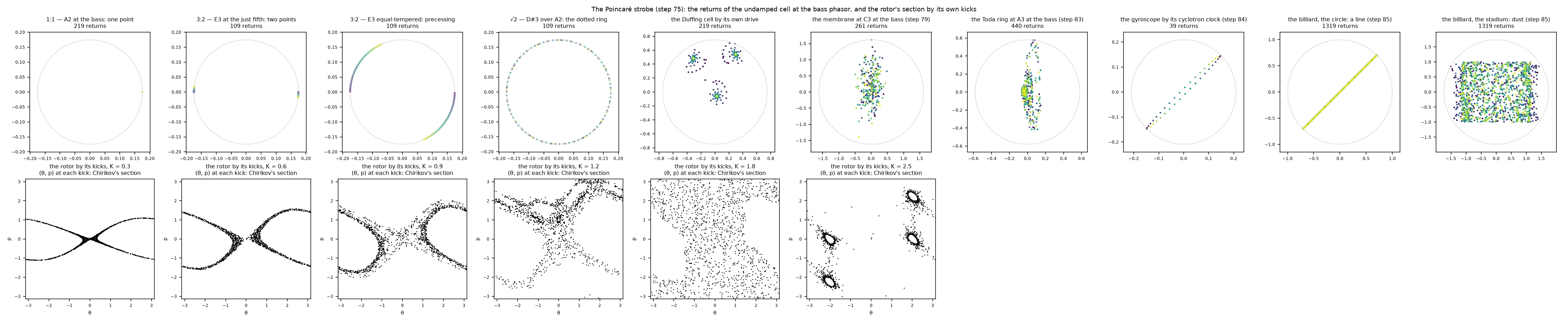
Section titled “The strobe”Under the Poincaré strobe at the bass — its own note — the ring returns once a period, 440 of 440 over two seconds at A3 under full press, and the points walk the section: the train outruns the note, so each return catches the pulse elsewhere on its lap. The trace’s aux pair is the biggest soliton and the drift.
The profile
Section titled “The profile”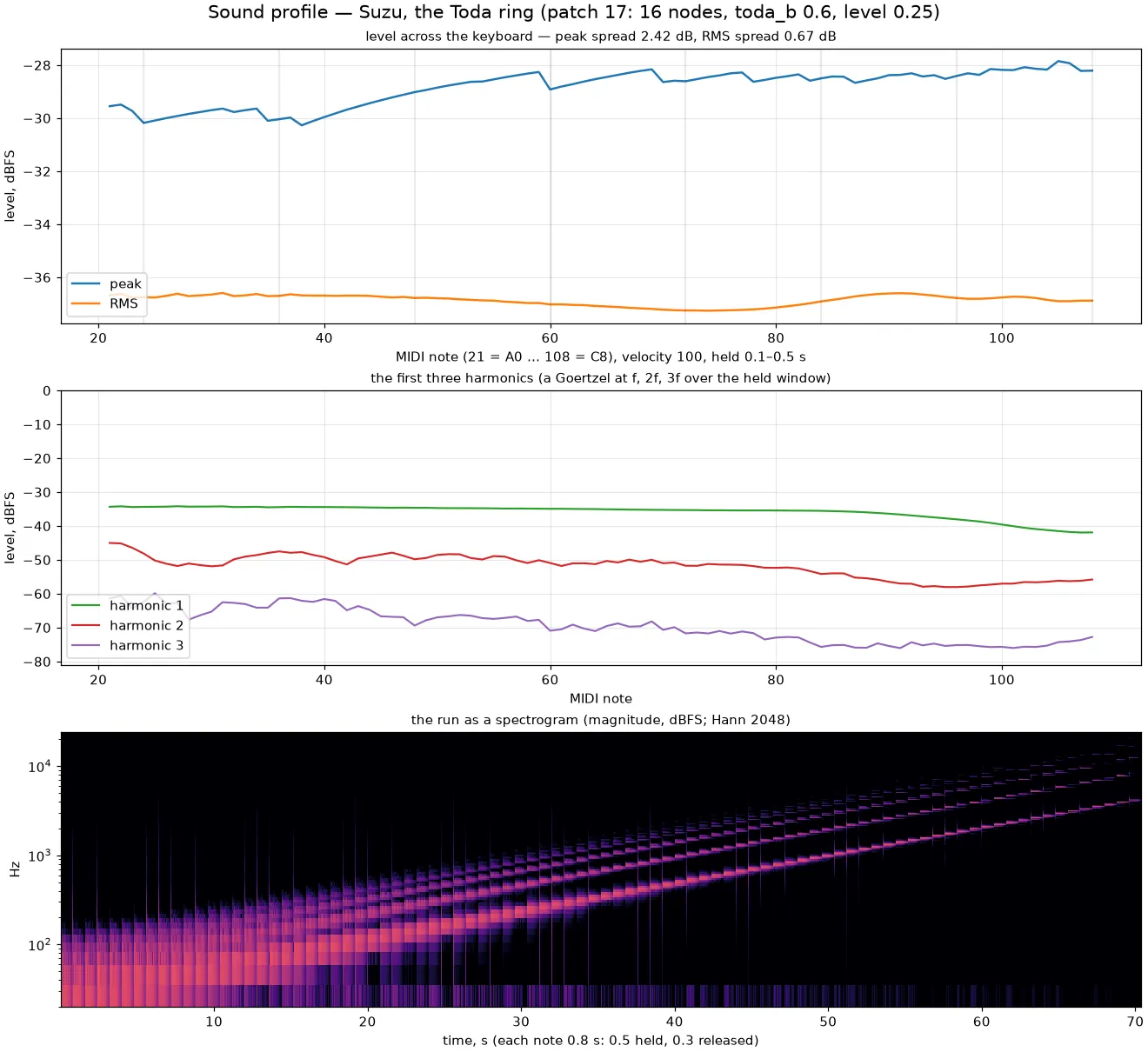
The Toda ring patch is the eighteenth of the table; the desktop’s Sound section carries the nodes, the nonlinearity, the cap and the pulse width; a preset file carries the same four fields (schema 2, a file from before leaving them at the defaults).
midi-sink 2.0.0 · AGPL-3.0 · source