Membranes, plates and gongs
The sheet
Section titled “The sheet”Where the chain gives a string’s body, the membrane gives a drum’s: an grid of displacements and momenta inside a ring of zeros, with
— the tension’s wave speed, the plate’s biharmonic stiffness, all in grid units ( at the 2× section’s rate). The step is the leapfrog’s kick, every force read from the pre-update positions — — then the declared contraction, then the drift . The kick-then-drift map has exactly, and for the linear sheet it conserves a quadratic form to the last bit of rounding: the undamped grid run for ten minutes at 96 kHz drifts by a few ten-thousandths of a decibel.
The boundary is declared: simply supported. The ring holds and , so the biharmonic is the five-point Laplacian applied twice through the same zero ring, and the mode table is closed-form:
A clamped edge would put the partials elsewhere; the suite measures the (1,1), (2,1) and (1,2) peaks against this table within a cent, for the membrane and for the plate. The grid is a rectangle — the rows are 13/16 of the columns — so the degenerate pairs split and the spectrum reads as a drum’s rather than a square’s.
Pitch, stiffness, and the cut
Section titled “Pitch, stiffness, and the cut”The note is the (1,1) mode, placed through — continuous, so a glide retunes the sheet per sample as the chain does. Suzu drum stiffness is the biharmonic share of that mode’s stiffness: at 0 the sheet is a membrane whose partials go as (the drum’s compressed inharmonic series), at 1 a plate whose partials go as (the wide spread of a struck plate), and the note stays on the (1,1) at any share. The grid is cut per note: the leapfrog’s bound is on the top mode,
with the continuum’s 8 and 64 (the grid’s own is a hair under, the safe side), and since is times a factor of the grid, the share and the swell alone, a high note takes the largest grid under the bar — sixteen columns to about C7, eight at C8 — and on the two-by-two grid past it the pitch saturates, as the chain’s does at its bound. The strike is a raised-cosine bump of momentum at the pluck position on both axes, scaled by so the pickup’s displacement reads the level across the keyboard; the pickup reads the sheet at its position, mirrored.
The damping is the lattice’s law on a grid. contracts the mode at by : Suzu decay (s) is the fundamental’s T60, decay brightness the extra rate per — the air’s and the thermoelastic loss, declared, the brighter modes dying first. The factor acts on the momentum, whose rate is twice the amplitude’s, and the suite reads the declared T60 back within a percent.
The gong
Section titled “The gong”The tam-tam’s pitch swell and its cascade on a hard strike come from the Berger / von Kármán stretching: the sheet’s mean squared gradient — one scalar read off the Laplacian pass, since — enters the Hamiltonian as , and the kick’s becomes . The force depends on alone, so the nonlinear update is still an exact momentum shear: in the whole phase space, one multiply-add a node. Suzu gong swell is in the player’s units: rises to at the cap’s stretching. The gong patch (swell 0.8) strikes C3 a hundred cents sharp at velocity 127 and two cents sharp at velocity 30, and a second later both sit on the note.
The cap, and the gate at . Because rises with amplitude, the CFL number is evaluated at the most stretching a strike can leave: Suzu strike cap bounds the plain energy a strike may leave in the sheet, in full-velocity strikes — a re-strike on a ringing drum never exceeds it, the momentum scaled down to the remainder — and since , the bound follows by arithmetic. The load gate refuses a Courant number forced past the bar with its sentence; with the gate bypassed the harness blows up within a second and the bus breaker cuts the block. The class’s own red control displaces a sheet tuned to the bar to 1.2 times the cap’s stretching, with the top mode seeded: it diverges within a hundred steps.
One finding is the gong’s own bar. A pure membrane at swell 1, displaced to exactly at with the top mode seeded, diverged — the (1,1)‘s stretching modulates the top mode’s stiffness by the whole swell at twice its own rate, and that close to the edge the modulation is not adiabatic — and held at 1.90 for swells up to 2. The gong’s bar is 1.80; a biharmonic share lowers the modulation’s depth further, and the real strikes of the gong patch held at every note.
The bus plate: the canvas as a soundboard
Section titled “The bus plate: the canvas as a soundboard”The second topology is one membrane on the bus, at the output rate,
stepped once a sample whatever the voices are doing: every Suzu voice feeds
its own sample into the plate at its point — on a play surface the
layout cell’s centre, set before the note-on reaches the engine
(voxo_set_strike_point); from a wire or the desktop’s keyboard a default
map, the note along the plate’s length and a golden-ratio scatter across
it, so neighbours share no null — and the plate’s two pickups, mirrored,
join the stereo sum before the reverb. It rings on after the notes end by
its own declared contraction, and under Kessho its strikes are seen where
they are heard.
The biharmonic bound scales as , so the plate is near-membrane: at 64 × 64 and 110 Hz the declared share 0.003 sits at 1.48, and a share asked past the gate is clamped, not refused — the plate is a bus element — with a log line that says what it took. The tablets take the mobile tier, 32 × 32, where the same tuning reads 0.46. The Harp on a soundboard patch is the concert harp over the plate: under a C3–G3–E4 chord the plate’s signal sits nine decibels under the dry strings, and with the plate off the render is the concert harp’s bit for bit.
What it costs
Section titled “What it costs”Sixteen membranes at 16 × 13 cost a sixth of the callback on the Release build (16.5 %, four lanes a row on NEON; the bar is 30 %); the 64 × 64 plate under one voice the same again (16.3 %); the mobile tier’s 32 × 32 a twenty-second. The storm — fifteen channels of the drum, of the gong and of the harp on the soundboard for twenty seconds from the Release build — reads 0 XRuns with the render under 0.8 ms of the 2.667 ms period.
The strobe
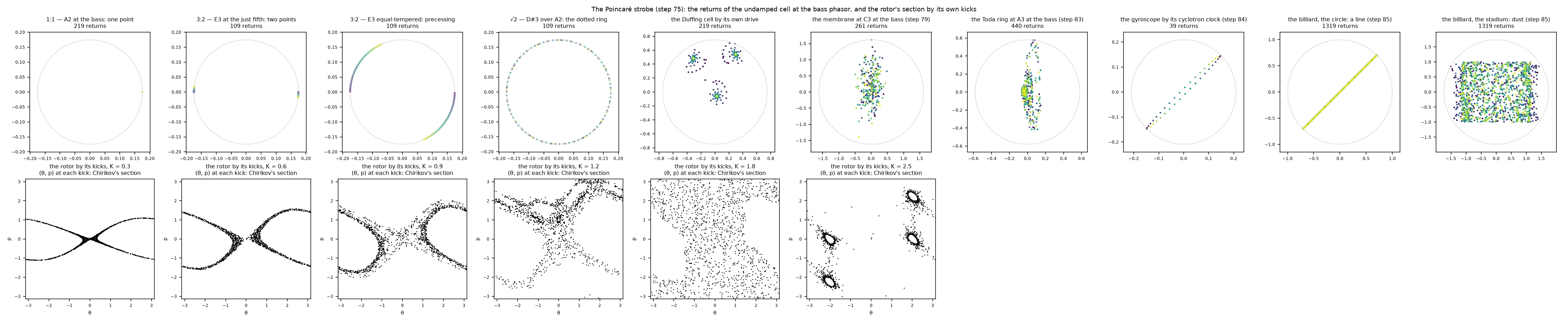
Section titled “The strobe”The membrane traces its pickup against its scaled derivative, with the stretching and the effective as its aux pair; under the Poincaré strobe at the bass its returns scatter, as an inharmonic spectrum’s must — the chart’s membrane panel.
The profiles
Section titled “The profiles”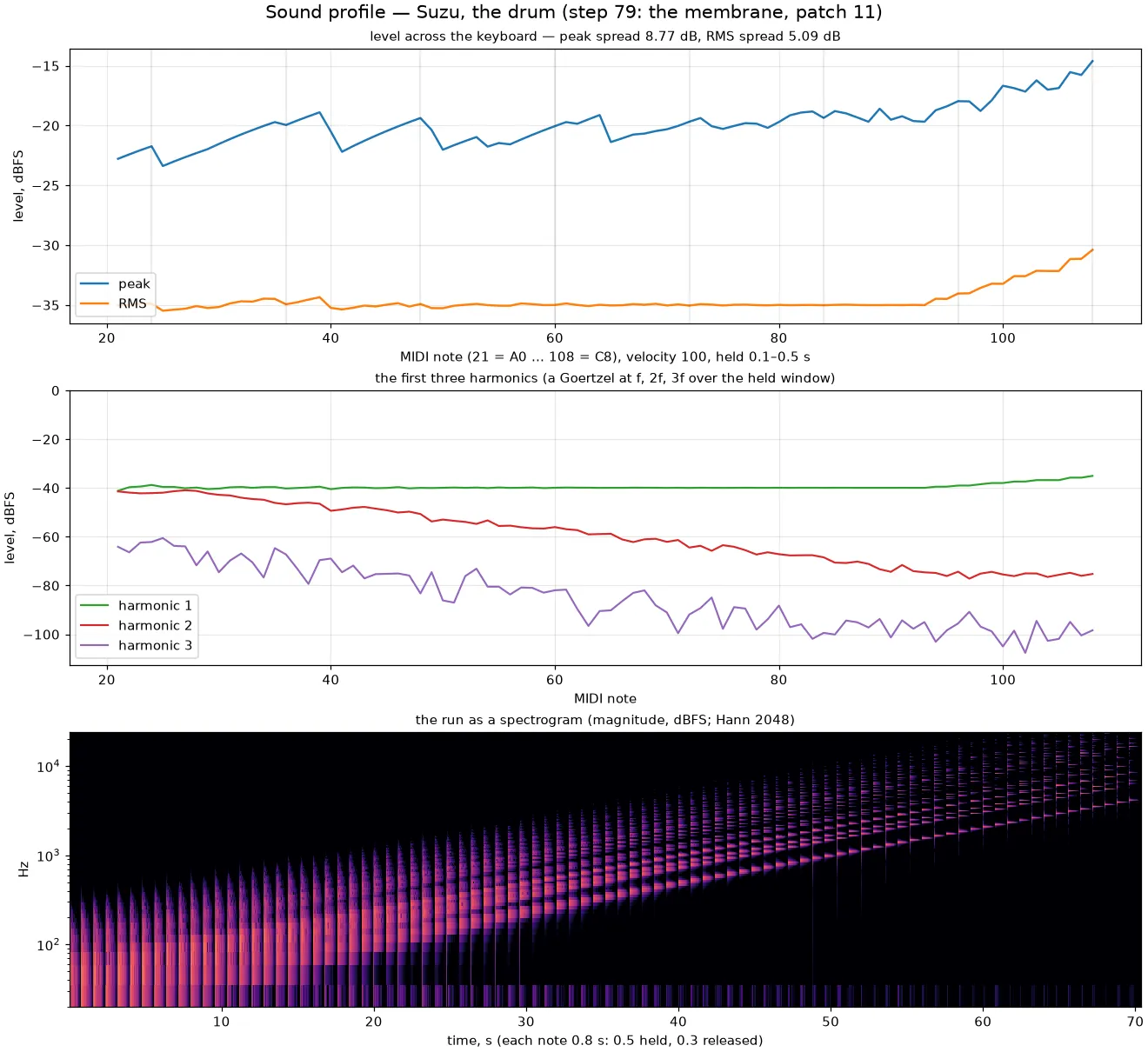
The drum patch: a 16 × 13 membrane, share 0.02, the fundamental’s T60 1.2 s and the brighter modes faster. The level across the keyboard holds within nine decibels of peak (the grids shrink above C7, and a smaller sheet rings a little louder at the pickup); the harmonics’ rows are the inharmonic partials nearest the multiples.
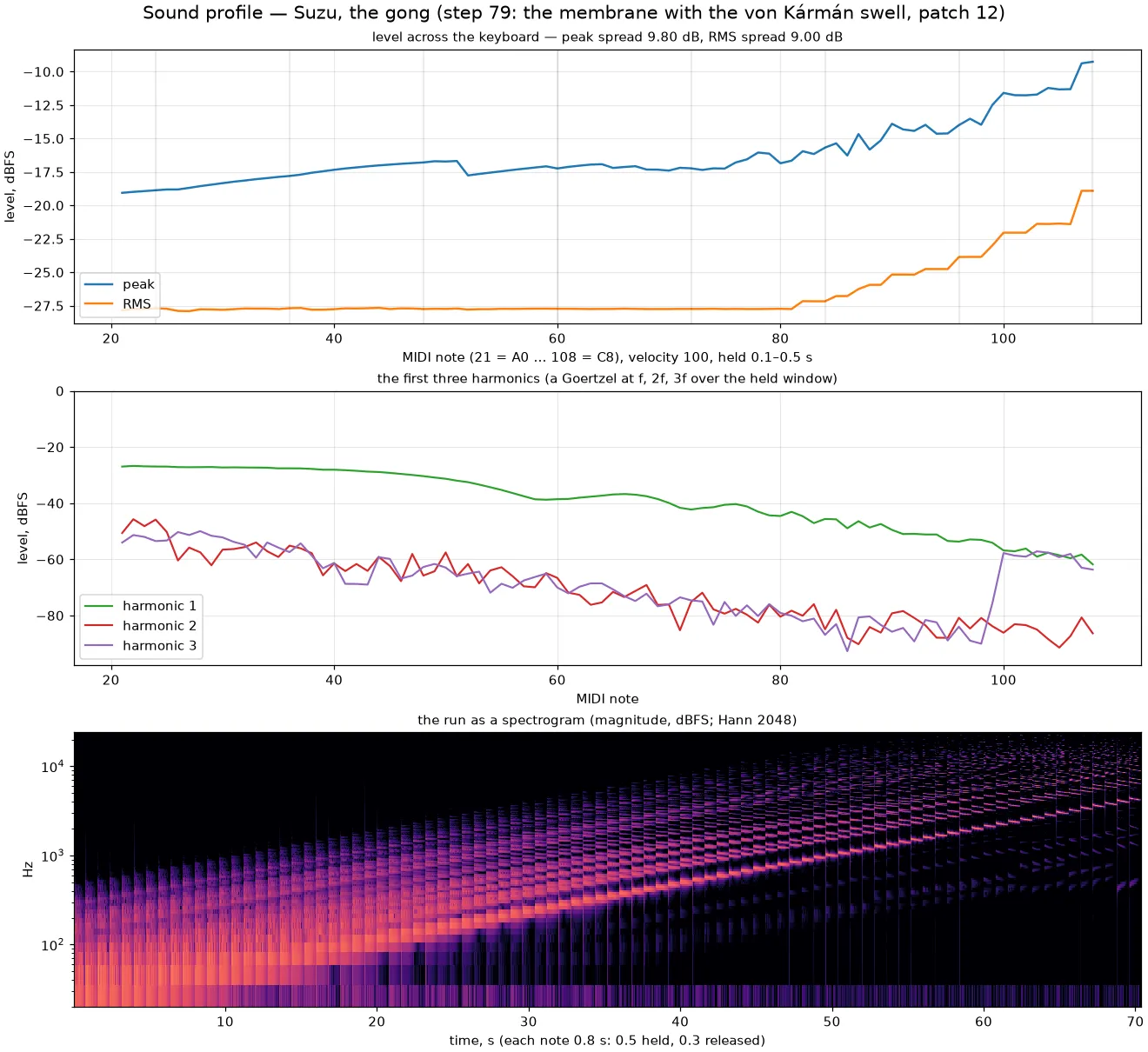
The gong patch: share 0.08, swell 0.8 at a cap of one and a half strikes, the fundamental’s T60 six seconds. The spectrogram shows the swell — every strike’s partials start high and glide down onto their places as the stretching decays.
midi-sink 2.0.0 · AGPL-3.0 · source