The gyroscope
The particle and the field
Section titled “The particle and the field”Put a charged particle on the note’s spring in two dimensions — positions , velocities in the cell’s units, so that a free orbit is a circle — and switch on a magnetic field perpendicular to the plane. The spring pulls the particle back; the field bends its velocity sideways and does no work, because the Lorentz force is always at right angles to the motion. The energy
is the spring’s alone, and the field only turns it round.
The step is the Boris leapfrog, the particle-pusher of plasma physics: half a kick from the spring, ; the exact rotation of by the field’s angle ; the other half kick; then the drift . Every factor is a shear or a rotation, so the map preserves phase-space volume exactly — — and, as the roadmap foresaw, it is not energy-exact once the spring’s kick is split round the rotation: the energy breathes with the splitting, by a few hundredths of a decibel, and does not drift.
The rotation deserves a word. Written as a cosine–sine matrix it would be exact in arithmetic and wrong in floating point: a matrix whose misses one by a unit in the last place scales the energy by that amount every sub-step — over ten minutes at 96 kHz, a drift no bounded-energy gate survives. Suzu writes it as three shears, , then , then again, which is exactly and, like every other shear in the engine, rounds as a walk rather than a bias. The state is double, as the Toda ring’s is.
The Zeeman doublet
Section titled “The Zeeman doublet”In a field the degenerate two-dimensional oscillator splits into two circular modes, one turning with the field and one against it:
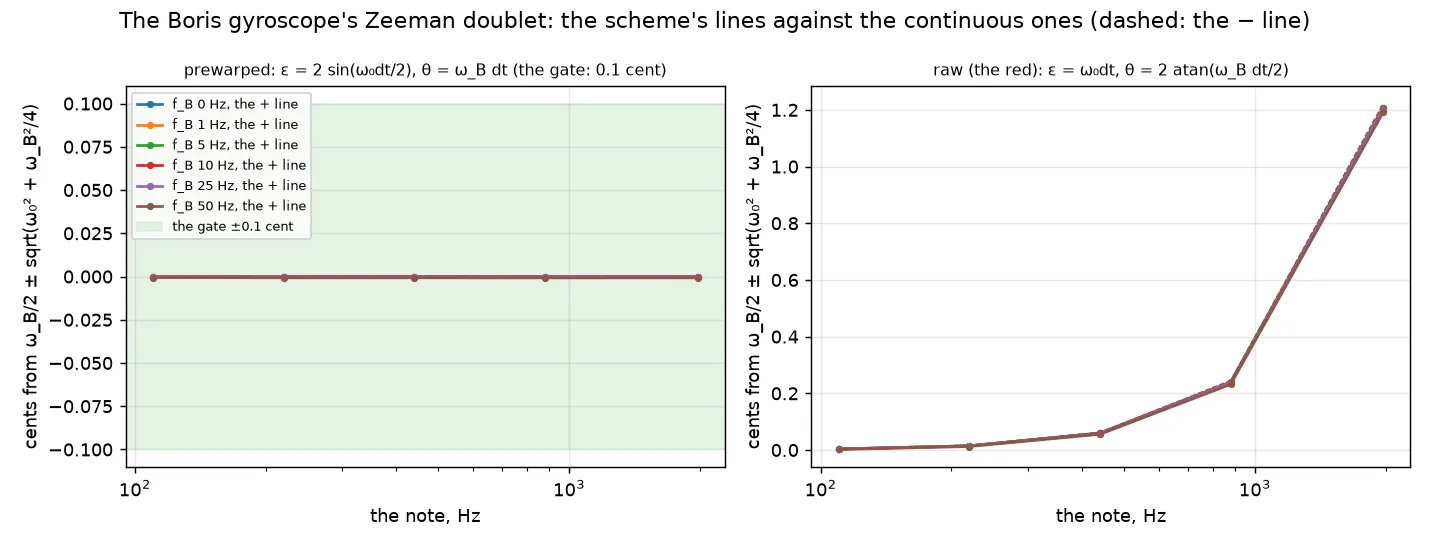
two lines apart — the Zeeman effect, with the note for the atom. The scheme sounds them exactly when both the spring and the field are prewarped: (the magic circle’s) and (the Boris angle with ). On and the step is a complex-linear two-by-two with trace and determinant , so its two angles are with — the doublet to , a thousandth of a cent at fifty hertz. The suite reads the two angles off the struct’s own map (two basis steps, the eigenvalues of the two-by-two) over five notes and six fields: within 0.001 cent of the formula, and the rendered left channel at A4 under a 20 Hz field has both lines within 0.000 cent. With the prewarp off — the raw and the raw Boris angle, the lab’s red — the pair is 1.21 cents sharp at B6.
Stereo
Section titled “Stereo”The two positions go straight to the two channels: is left, is right. The strike is a displacement along the cell’s position by the equal-power pan law, : at the centre both channels hold the same bits and the voice is a mono planar string — a line in the plane — and at either edge one channel alone. The field turns the line: the two circular modes beat against each other and the orbit precesses into a rosette, left and right in quadrature (their correlation is zero at 20 Hz), the lush, phase-locked shimmer the proposal promised and the quadrature stereo item of §13.2 answered.
The field is the poly pressure’s, in hertz: field at rest with no pressure and field at full poly pressure under the finger, the patch’s 2 and 24 Hz, smoothed with the swirl and refitted every block. A patch with the rest field at zero is the proposal’s mono string until pressed; the default keeps a keyboard without poly pressure in stereo.
The strobe and the spirograph
Section titled “The strobe and the spirograph”The trace draws as they are — the spirograph on the canvas, a line that opens into a rosette as the field rises; the energy and the field are its aux pair. Under the Poincaré strobe the voice offers its own clock: the cyclotron period, one return per full turn of the field, and the section is the rosette’s lobes as a closed figure. With no field the own clock falls back to the bass.
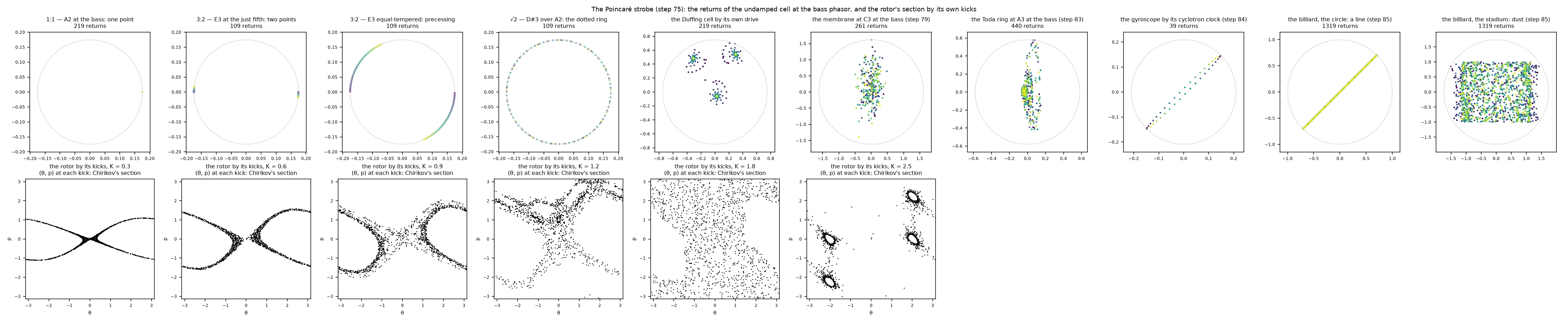
The bench’s --boris-demo traces four notes under a pressure sweep into
Kessho — the crystal shows the rosette as its iso-trace — and into Anod’s
spark reading; the stills are in the step’s evidence.
What it costs
Section titled “What it costs”Four doubles, two shears and a rotation a sub-step: a quarter of a percent of the web’s quantum, and bit-identical there to the desktop, since no library function sits in the step. The storm and the tablets do not notice it. Ten minutes lossless at A3 under a 20 Hz field hold within ±0.031 dB of its start with the minute means drifting 0.000000 dB.
The profile
Section titled “The profile”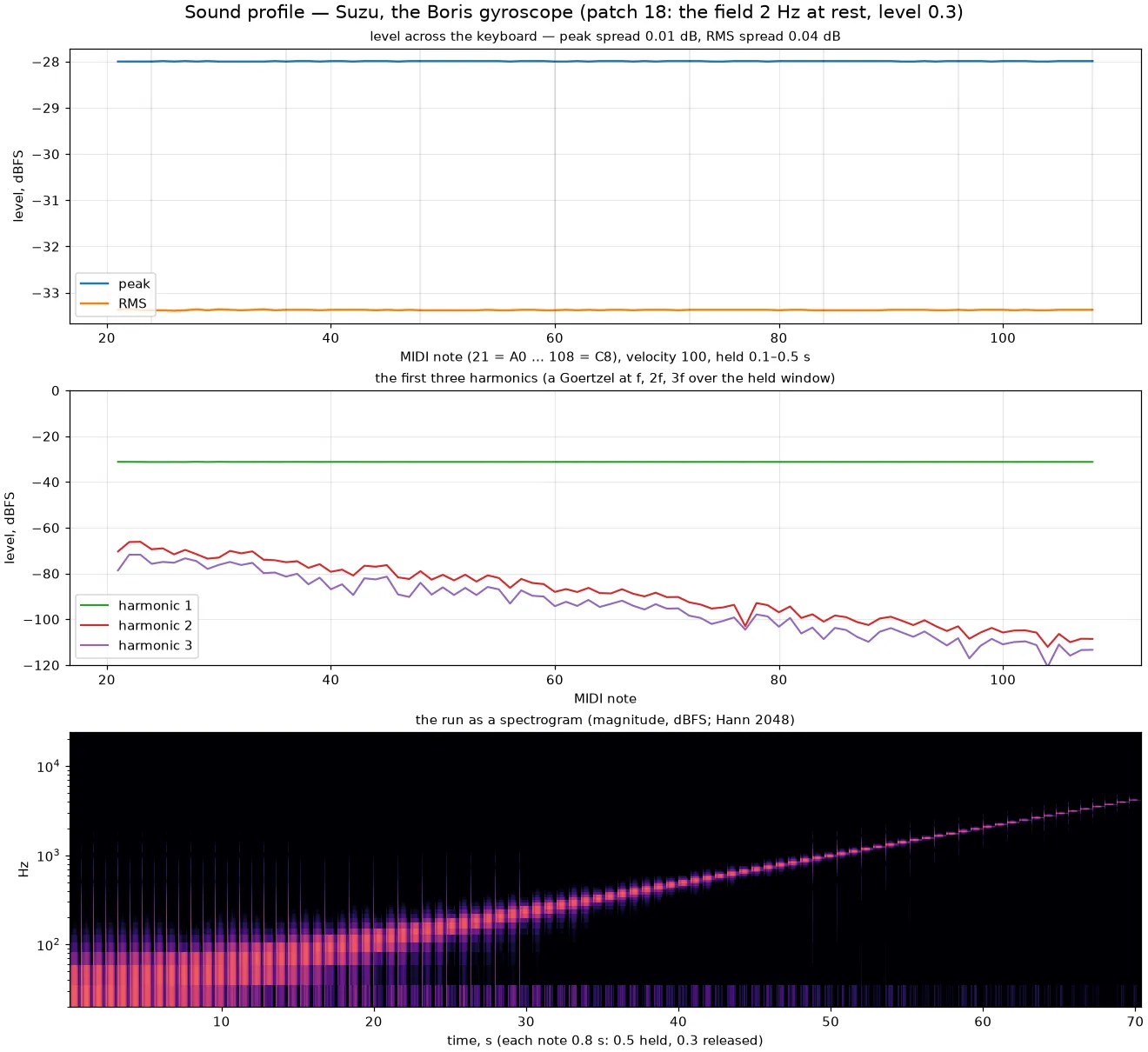
The Gyroscope (Zeeman stereo) patch is the nineteenth of the table; the desktop’s Sound section carries the two fields, the decay and the pluck position as the pan; a preset file carries the two fields (a file from before leaves them at the defaults).
midi-sink 2.0.0 · AGPL-3.0 · source