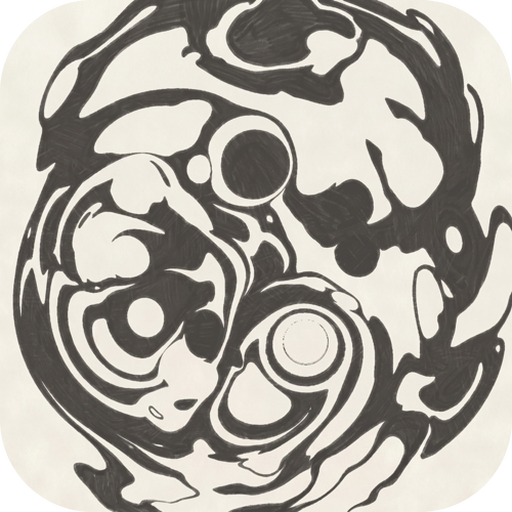
Chord wave
Lineage. Jaffer’s comb and v2’s ripple: a shear along one coordinate by a function of the other is exact for any profile, and the sine ripple’s bake pass already composes additively. The chord wave is that pass given a direction, a wavelength and a window by the note.
What it does. Under Kessho the poly pressure of a held note (0xA0, the swirl’s dimension in Sumi) is the amplitude of a ripple-tine through the note’s drop:
in the band’s own coordinates along . The axis is the pitch class’s angle on the circle of fifths, fifteen degrees a step so the twelve classes are twelve distinct orientations across a half turn: C runs flat, G fifteen degrees up, D thirty, and round to F. The wavenumber is the octave’s: four periods across the canvas at octave three, doubling every octave up, between two and thirty-two. The window is a bump across the band, two and a half drop radii either side of the note, so the tine spans the canvas along and is windowed only in ; the phase puts a crest on the note. The pressure drives the amplitude as deltas, as the ripple bake does: pressing in lays the wave, easing off takes it back, holding adds nothing, and the wave stays baked when the note lifts.
The lattice. Voices compose as separate passes. One note is a band of parallel ripples; two notes are two bands at their classes’ angles, a lattice where they cross; three and more the crossing region of three bands. Each pass is a shear by a function of alone, windowed or not, so every one has exactly and so does the composition.
Route (b), the rosettes. The proposal’s local rosettes — a generating-function shear windowed in both coordinates, a two-by-two Newton per note per texel — are the only way to the quasicrystalline three-, five- and six-fold figures of the first draft; they are prototyped only after this route has been seen on paper, the author’s call.
Ownership
Section titled “Ownership”- Poly pressure under Kessho, per note. No setting, no gesture of its own; the ripple’s gesture serves.
In the bench
Section titled “In the bench”--chord-wave-test: one note’s band fitted to its sinusoid, the parallel
lines, nothing outside the band; a fifth’s two bands and their crossing;
the renders in Sumi and Kessho. --soak chord_wave the four-part gate (the
pairs at ); the headless suite the records.
midi-sink 2.0.0 · AGPL-3.0 · source